Chairman of the World NGO Peace Ambassadors Council
Chairman of the Nagasaki Council for the Promotion of the Japan-Korea Tunnel
Katsuyuki Kawaguchi
Background: Completed Master's course in Mechanical Engineering at the Graduate School of Engineering, University of Tokyo. Doctor of Engineering.
After working in the design and research and development departments of Mitsubishi Heavy Industries, Ltd. and as a French government technical researcher at SNECMA, the French national jet engine research and development company, he is now a professor at Nagasaki University and Nagasaki Institute of Applied Science. He is also actively involved in NGO activities, including serving as the executive committee chairman of an African school construction support project for 15 years.
His major publications include "Theory of Global Environmental Systems Design" and "Research into the Expression of Human Inner Sensibility." He has over 100 registered patent applications.
The Pope has strongly criticized the current economic order in countries like the United States and Japan, which he says is driven by profit-first mentality and environmental destruction, and warned that "those with political and economic power are trying to cover up this problem." The historical era of "collecting" is coming to an end. Historically, when "collecting" reaches a dead end, a "battle between land and sea" arises. The Japan-Korea Tunnel is a bridge between these "land nations" and "sea nations."
The heartland of Eurasia (from the Siberian Plain south to Iran and Europe) is the last "economic frontier" on the Earth's finite surface, and it is said that whoever controls the heartland controls the world. Collaborative efforts to build a decentralized energy society based on the Global Environmental Design Theory I will discuss below will greatly build trust and friendship across the Eurasian continent. Rather than a "battle between land and sea," we will create a highway of trust and economic peace between land and sea. Now is the time to move forward with a future-oriented Japan-Korea tunnel and North Korea energy highway initiative, and the core of this will be for both countries to build friendly relations while improving themselves through these efforts.
The Japan-Korea Tunnel will connect the continent and Kyushu via an East Asia Intelligent Power Grid (an energy management system that shares electricity generated from distributed energy sources among countries). The most promising method is to generate electricity from wind power in the Gobi Desert in southern Mongolia and transmit it. Japan's electricity rates, which are the highest in the world, would be reduced to below those of the United States, solving the CO2 problem and maintaining economic growth and employment as a national long-term plan. The Japan-Korea Tunnel will reveal various concepts for the future. We will consider these ideas from the perspective of intelligent design (optimal design), a new way of looking at things.
*This summary was given at the Japan-Korea Tunnel Realization Kyushu Liaison Council in December 2015. Each chapter in the main text is designed to have a complete argument. I would be grateful if many people would consider it and share their thoughts with me.
When I was young and doing training at SNECMA (National Aero Engine Research Company) as a gas turbine researcher for the French government, I heard that one of the questions in the French university entrance exam (Baccalaureate) was, "Are preconceptions or stereotypes good or bad? Explain with examples." Each student was required to spend 1.5 hours to verify their preconceptions.
At that time, there was no "experiential learning" in the "education world," but I intuitively felt that Japan could not compete at all with "this country's educational philosophy and policy for educating people."
I've entered the final stage of my life, and have accumulated experience through various experiences, including working in corporations (both domestic and international), national universities, private graduate schools, and global NGO activities. However, when it comes to enormous problems, such as transforming a "centralized society" into an "autonomous decentralized control society" (where the brain's information processing system is autonomously decentralized), the issue of notation always comes to mind. In other words, "there are good cases and bad cases, so the decision is difficult." Breaking down the issue, I decided that if I ultimately decided on the Japanese "eight million gods," which one would be chosen, there would be fewer mistakes.
From the perspective of "complex adaptive systems," this type of problem-solving "method" is called "intelligent design," which is a "common solution" to all problems and is currently thought to be the most advanced "methodology."
In "Kazuchigusa," Yamada Takao quotes Tolstoy and says:
"If your mind is blank, you can explain even difficult problems to others. However, even an intelligent person cannot convey even simple facts if they have fixed ideas and preconceived notions in their mind that "I know it all without a doubt."
In other words, "ignorance" is a state in which one's head is filled with "knowledge" and there is no room for new "perception." There are many experts who think like this.
Until now, policymaking has been in the hands of experts, bureaucrats and politicians, under the guise of democracy. Following the Great East Japan Earthquake and subsequent nuclear meltdowns, as seen in the STAP cell scandal, there has never been a time when the "knowledge" of experts has been called into question. The erratic behavior of experts after the Fukushima Daiichi nuclear disaster was enough to disappoint and distrust the public, and problems have also surfaced about the approach to research and development that relies solely on experts.
As Queen Elizabeth pointed out, why did prominent scholars, government officials, and "wise men" in the American financial world fail to predict the "great economic crisis" of 2008?
Furthermore, the reckless megaproject of the New National Stadium, which was carried out without any consideration for cost and technology design, and the argument for abolishing liberal arts universities, stem from the "nature" of the political-bureaucratic community, and are a direct reflection of the history of Japan's irresponsible system, which ignored history and led us down the wrong path from the Sino-Japanese War to the Pacific War.With the exception of the privatization of the Japanese National Railways (supported by Doko Toshio, then chairman of the Japan Business Federation), there have been no successful examples of megaprojects led by the state, whether it be the Resort Law or "public works" that exceeded the means of local communities.
This is what government ministries and agencies always do. They don't know the methodology (know-how) for developing "new things." They decide "matters" at expert meetings. They don't "realize" that these expert meetings are making the problem more complicated. They lack imagination and creativity.
This is because there is no participation from "ordinary people," that is, "collective intelligence, the collection of bodily intelligence, synchronicity with others, synchronicity of the group" (see "Points of View" I, II, III, Katsuyuki Kawaguchi, World Peace Professor Academy). "Collective intelligence" is "the knowledge inherent in a collection of living systems," and when it comes to creating something new, it can be rephrased as intelligent design (optimal design).
In other words, "cost" appears as a symbol of the design philosophy of "Simple is Best" (which includes "beauty," minimal cost, and a small number of parts, resulting in a long lifespan and low operating and maintenance costs), the client's demands, safety and efficiency, lifespan, material deterioration over time, number of parts, operating and maintenance costs, and the cost of multiple layers of protection. This is why the designers know what will break. The design of the National Stadium was chosen because it is simply large, does not harmonize with or coexist with nature, and has no sense of cost. They have no understanding of what intelligent design is. This is the actual value in the real world.
Intelligent design (optimal design) is synonymous with "God's creation."
In order to maintain the eternity of "life," there is a method of periodically recreating something that is exactly the same, even if only partially. Living organisms periodically produce offspring that are identical to themselves, in order to preserve their "self-form" forever.
Living systems use this method to reproduce genetic information through reproductive cells, attempting to pass on the morphology of somatic cells forever. They periodically produce offspring that look just like them, and then return to the earth. Life has spent 3.5 billion years developing this mechanism, and nothing is more certain than this. Moreover, it is from this that the spirit of "mono no aware" is born.
Why was the wooden Itsukushima Shrine able to stand on the sea for over a thousand years?
To embody "eternity," which is the intersection of religion, literature, social science, science and technology, and art, we need design considerations that incorporate the following ideas. Specifically, we design a system that combines parts that are designed to be strong enough to withstand destruction with parts that can be predicted to break, and this protective effect maintains the safety of important parts. Rather, we design parts to be fragile, and by replacing them when they break, we protect the most important architectural features of the shrine building. This is the true core of intelligent design (optimal design) (see "Research into the Expression of Human Inner Sensibility," by Kawaguchi Katsuyuki, Creative Design Association).
Professor Emeritus Watanabe Hisayoshi of Kyoto University was the first person to take up the theory of intelligent design academically and introduce it to Japan. He explains it in a very emotional and technical way, quoting the words of Michael J. Behe as follows:
"Intelligent design is the purposeful composition and arrangement of parts (components)," and this, as shown in the diagram, brings about "God's creation."
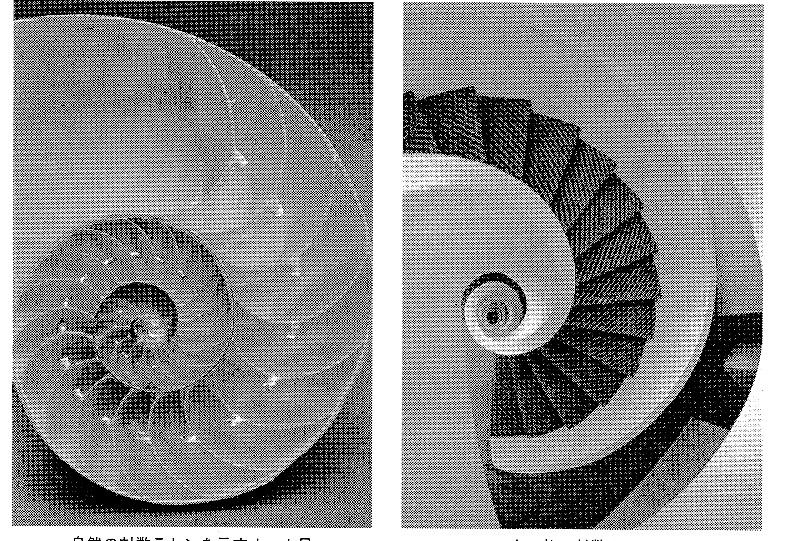
Left: A scallop showing natural logarithmic spirals.
Right: An artificial logarithmic spiral.
Figure 1-1 The wonder of morphogenesis in nature, the ultimate limit of order (Kaneko 1989)
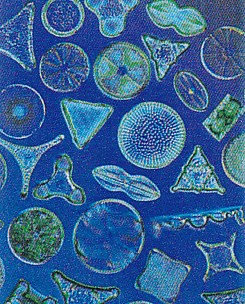
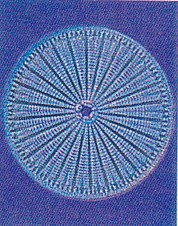
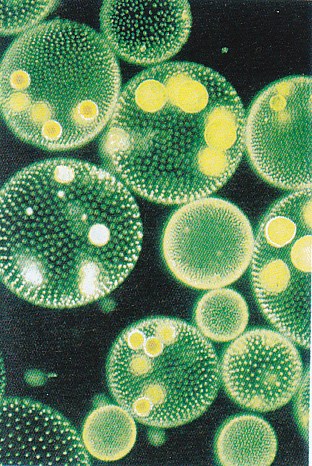
Figure 1-2: Single-celled algae with flagella
. Even in the ultra-microscopic world, each function is condensed and the pattern of the entire system is contained. The coordinated movement of the flagella allows movement and rotation.
(Hildebrandt 1994)
This paper can be downloaded from the link below.