Chairman of the World NGO Peace Ambassadors Council,
Chairman of the Nagasaki Council for the Promotion of the Japan-Korea Tunnel, Katsuyuki Kawaguchi
-From the theory of intelligent design (optimal design)-
Pope Francis addressed "everyone living on this planet," urging us to "change our lifestyles, which include our faith in high technology, our reliance on fossil fuels, and our impulsive consumption," saying, "global warming and environmental pollution are human-made problems." He went on to strongly criticize the current economic order in countries like the United States and Japan, which he said is driven by profit-first mentality and environmental destruction, saying, "Those with political and economic power are trying to cover up this problem."
Furthermore, Carl Schmitt and Kazuo Mizuno have argued geopolitically as follows:
The historical era of "collection" is coming to an end. When "collection" reaches a dead end, it is common in history that "battles between land and sea" arise. The Japan-Korea Tunnel will become a "bridge" of peace between these "land nations" and "sea nations."
"Money is a circulating thing in the world." However, when people become anxious, the circulation of money slows down. Thawing frozen money flows is the true meaning of a "negative interest rate policy." The monetary base has tripled over the past three years, but this is not how it works in Japan today. People's anxiety about the future has already grown too great. This is because their assets have been damaged too much by years of ultra-low interest rates. They start saving their money in safes, hiding it under the guise of a membership card for Tomonokin.
How can people be so bold as to spend money when they are treated like this? How can they take the "action" of spending their meager savings to buy "stocks"?
They are not paying attention to people's "emotions and feelings." In other words, they are not seeing "people." Hirofumi Uzawa (1928-2014), like Piketty, was a mathematician, but he created the "Social Capital Theory" from econometrics, reconstructed "an economy without environmental destruction and people," and proposed the new idea that "the economy is people." They are not aware that the economy needs this kind of "collective intelligence."
From a sensory-technical perspective, that is, from the perspective of intelligent design (optimal design theory) of "complex adaptive systems," this is the same as what Ninomiya Kinjiro said: "An economy without morality is the same as crime, and morality without economics is nonsense."
This new way of thinking is impossible within the scope of traditional economics (Kawaguchi Katsuyuki, "World Peace Studies," 2016, "On Perspectives I and II"); it ultimately becomes a "collective intelligence" that integrates religious, artistic, and scientific and technological thinking. Therefore, intelligent design (optimal design) of "complex adaptive systems" seems to be the most suitable "way of thinking" at present. Rising stock prices and sluggish consumption also occurred during the Lehman Shock. Based on the facts, the Japanese economy will not grow through monetary easing. The only way forward is to develop the heartland, the "final economic frontier."
"The design of the New National Stadium seems cursed," economist Ryuichiro Matsubara wrote in response to Moriyama Koji's book, "The Unconventional Construction Industry," published by Kobunsha Shinsho. "However, if they had gone ahead with Zaha Hadid's plan, we would have ended up in an even more frightening situation."
The touted arch keel (375m long, 76m high) is too huge to be physically constructed, there is no sub-track for track and field and field, it cannot be used for the World Championships, the natural grass dies when the roof is closed and it cannot be used as a soccer or rugby field, if the roof is left open music events attracting 80,000 people become a source of noise, there is no route to the station, and the packed crowds become refugees until late at night. Furthermore, the 300 billion yen cost of new construction and the annual maintenance and repair costs will be borne by the people in the form of taxes.
I empathize with this assessment, as an economist who is capable of comprehensively examining and evaluating "religion, art, and science and technology," in other words, capable of intelligent design (optimal design) of "complex adaptive systems." I feel that Ryuichiro Matsubara and Masaru Kaneko share a common "sensibility."
The simultaneous occurrence and scale of the earthquake and tsunami may have been excessive and "unforeseen." However, the job of planning and design (this is called intelligent design) is to anticipate what kind of response (safely shutting down) should that occur. As mentioned in "Points of View" I and II, "unforeseen" events can be avoided through design.
In Zen, there is a saying that goes, "The very essence of creation is nothing." I have this moral teaching by Kenzan in a scroll of calligraphy in my home, and I sometimes hang it on the tokonoma alcove and look at it, so I remember it well.
This is also true of the spirit of the tea ceremony, but the Great East Japan Earthquake gave me a real sense of it. Human activities were taken away in an instant. It may seem paradoxical, but Kenzan's arrangement of words, "originally having nothing," - "not having anything at all" - strikes me as the pinnacle of intelligent design. It is based on facts, and it "begins" from there. The affection and sadness for fleeting, disappearing things, and the love and joy for new things that are born as we cut off those attachments - this feeling of "mono no aware" - is the essence of the Japanese "heart."
Playwright Yamazaki Masakazu looks at the recovery from the Great East Japan Earthquake from the perspective of Japanese history and civilization.
During the Edo period, large amounts of timber were stored in lumber yards. Edo was run and designed on the assumption that major fires would occur and houses would burn down. Major earthquakes could not be prevented, but if they burned down, they would be rebuilt. This was an embodiment of a proactive view of impermanence. This tradition is still alive today. In other words, houses were recreated using wood, paper, and silica (earth), and if they were destroyed, they were easily rebuilt without resisting nature. In other words, it was a design philosophy of "simple is best." It could be called "design that expresses the pathos of things." Leonardo da Vinci also said, "Simplicity is the height of sophistication."
Many "events" on Earth cannot be predicted or explained by established logic or morality. Responding appropriately and swiftly to such unexpected "events" is not something a centralized government can do. The only way to survive in an increasingly complex global world is to decentralize decision-making authority. This is the kind of fact-based , field-based intelligent design (optimal design) that is adopted by living systems. In other words, it is about creating an autonomous, decentralized, controlled socioeconomic order, similar to the way information is processed in the brain. An analogy would be fractal theory, or the "methodology" of Emmanuel Todd and Piketty.
In Japan, this is the "methodology" of Kinjiro Ninomiya, Hirofumi Uzawa, and Kosuke Motani. Fractal theory is effective in considering complex applied systems, and this is explained in detail in "Research into the Expression of Human Inner Sensibility."
I will now explain this in detail. Ideally, this would be the creation of a "locally produced, locally consumed decentralized garden city," as envisioned by Prime Minister Masayoshi Ohira.
Is the aforementioned "unconventional architecture industry" a problem with university architecture departments that insist on originality from the very beginning? The answer is no. Originality in all forms of design comes from adding unexpected interpretations and meanings to precise basic techniques, or from adding emotional expression. Take a look at Marcel Duchamp's "Fountain." Intelligent design, its essence, should be taught at universities. This is because intelligent design is the purposeful arrangement and composition of parts.
The United States, which started the trend of economic globalization, has now become unable to tolerate globalism. This will be a turning point for the world.
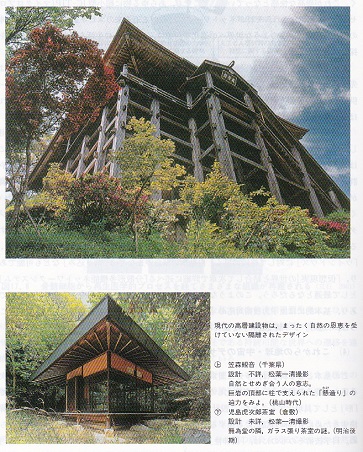
Figure 1.3 Kakezukuri and other structures designed with a clear purpose and intention (connection to nature)
"Muido Teahouse"
This paper can be downloaded from the link below.