◆Tsushima, the gateway to the Eurasian continent, will become a base for spreading peace projects - The current state of Tsushima, the border island -
Following the installation of the inclined shaft entrance last summer, construction work in Tsushima will require extending the entrance by 10 meters and improving the electricity and water environment, and we are now waiting for these preparations to be completed.
It is only 40km from Waniura, the northernmost point, to Busan, Korea, and it can be easily seen. Tsushima has been the main route connecting Japan to the peninsula and the continent since the Yayoi period, and was, so to speak, "National Highway No. 1." This is because even small boats could safely reach the island by sailing along the coast. Due to the adventurous spirit of the island, which could be seen in the distance, trade was frequently conducted in small boats, skillfully reading the weather and wind.
The Wei Zhi Wajinden, written by Chen Shou during the Three Kingdoms period in China, contains a detailed description of Tsushima in 200 characters. However, for us Japanese, the most interesting references to "Yamataikoku" and "Himiko" that appear later on are what inspire the romance of ancient history fans. Watatsumi Shrine is also the shrine where Yamasachihiko is said to have met Toyotamahime, the daughter of the sea god who later became his wife, and whose grandson was Emperor Jimmu, the first emperor of Japan. A torii gate leading from the sea leads to the main shrine, and when the tide comes in, seawater flows into the shrine grounds.
This waterway is the path that Princess Toyotama took to come onto land from her underwater palace. At its end is a three-legged torii gate, which leads to the main shrine. The Kojiki tells the story of the founding of ancient Japan, and this scene comes back to life here. Tsushima is truly an island full of historical romance.
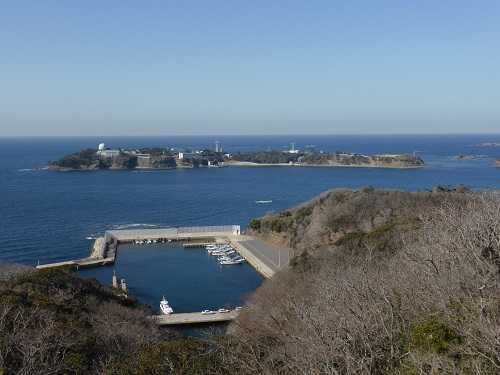
[Photo] View of Busan from the Korean Observatory in Waniura, the northernmost tip of Tsushima. Yellow sand and PM2.5 obscure the horizon.
Next to Watatsumi Shrine is Mount Eboshi. From the observation deck on top of the mountain, you can get a 360-degree view of the island. Tsushima looks like a string of small hills. Drowned valleys, created by mountain-building activity, create a complex coastline, and the suddenly deep seas nurture large fish. With little flat land, airports had to be built on top of mountains, making takeoffs and landings difficult when the wind is strong.
The natural environment of Tsushima is created by combining the ever-summer island of Hawaii with the drastic changes of the seasons. It is a beautiful island with clear blue skies and seas. Of course, only those who have eaten the seafood, which has firm flesh and grows in the fast-flowing Tsushima Current, can truly appreciate its deliciousness. "Winter yellowtail" is a local specialty.
There is a torii gate at the foot of each small or humped mountain. There are shrines that venerate the mountains as sacred objects, and simple mountain worship is still alive. There are ancient shrines, and there is also the "Amateru Shrine." The word is reminiscent of "Amaterasu." Tsushima is an island of sun worship, paired with Iki, which worships the "Tsukuyomi" god and the moon. The three gods, including Susanoo-no-Mikoto, are the last three gods born to Izanagi and Izanami when they created the land.
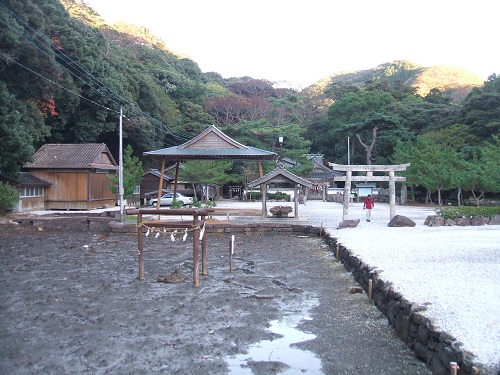
[Photo] Watatsumi Shrine: The three-legged torii gate holds a hidden historical romance
Tsushima's history is rich in important events, such as the many ruins from the Yayoi period, the Mongol invasions of the Kamakura period, the Korean missions of the Edo period, and the Russo-Japanese War of the Meiji period. However, today, with the Pacific era and America-centered diplomacy, these events seem to have been forgotten. Taking advantage of this, 180,000 tourists from Korea visit every year, and Hangul is flying everywhere on the streets of Izuhara, the central town.
Due to the low number of Japanese tourists, the tourism industry, including inns and hotels, is barely surviving. Furthermore, the lack of industry has led to a decline in population as young people move offshore to find work, and the island is also being hit by the wave of an aging population and declining birthrate. The same phenomenon is occurring in Iki, which we covered last time. Tsushima is not simply a border island. In this day and age, when trade with the world seems to be carried out by sea and air, there is no doubt that land routes are the trade routes that can bring about deep friendship and peace.
In that sense, the "International Highway" that will connect Japan from the peninsula to the Eurasian continent, and the "Japan-Korea Tunnel" and "Bering Strait Tunnel" that will serve as its starting points, can be said to be projects that will create a new culture. Is it an exaggeration to say that the concepts of "land routes" and "connected by land" will create a new Japan?