From October 14th to 16th, five members of the Aomori Prefectural Citizens' Council inspected the Karatsu Incline Shaft site and the Aren Incline Shaft site in Tsushima. Although Aomori is far from Tsushima, two members of the council had a strong passion for the island. Due to urgent matters, they were unable to attend this time, but the five members came anyway, with the words, "Please come and see for us instead." They walked the sites with their own feet, breathed the air with their own noses, and truly felt the significance of tunnel construction. This visit revealed that there is a passionate movement in Aomori to build a Japan-Korea tunnel.
Aomori and Tsushima have a deep connection. There were two Mongol invasions during the Kamakura period. We learn that when the Mongol army reached the coast of Hakata in Kyushu, a divine wind blew and sank many of their warships, allowing them to retreat to the peninsula without invading Japan. Before reaching Hakata, the Mongol army also invaded Tsushima and Iki. On Tsushima, the lord of the time fought back with 80 cavalry but was annihilated, and the islanders who fled to the mountains somehow managed to survive. On the other hand, on Iki, there were no mountains to escape to and the islanders suffered a tragic death.
When the Mongols invaded Tsushima, islanders who had boats on the east coast panicked and fled to the sea, but were swept away by the Tsushima Current and drifted all the way to the Tohoku region. They ended up on the west coast of what is now Aomori Prefecture. They were warmly welcomed by the local people and ended up settling in Tsugaru. One of their descendants was the birth of a famous writer: Osamu Dazai.
Dazai's real name was "Tsushima Shuji." Although he changed the kanji spelling to reflect the name of his former hometown, he was originally from Tsushima. Dazai's daughter also became a writer, but he deliberately hid this fact, as he did not want to be seen as riding on her father's coattails. The newspaper reported that his daughter had passed away last year, bringing her name to the public's attention once again. The "Tsushima" surname in Aomori originated from this place. While he wrote the moving "Run, Melos," one cannot help but sympathize with Dazai's deep sadness at the tragedy of his suicide by drowning.
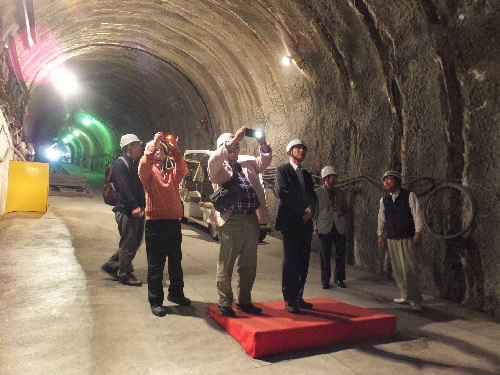
[Photo] The tip of the Nagoya Incline Shaft in Karatsu. Director Okubo's explanation highlights the scale of the project.

[Photo] Tsushima, Aren Inclined Tunnel Entrance: "A journey of a thousand miles begins with a single step," says the group, determined to expand the movement in their hometown of Aomori
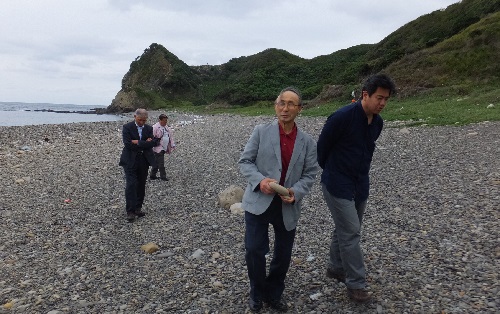
[Photo] Tsushima's Aren west coast. The tunnel will extend from here to South Korea. Mutsuo Kimura, vice chairman of the Prefectural Residents' Council (center).