 On November 10, 1981, the 10th International Conference on the Unity of Sciences (ICUS) was held in Seoul, South Korea. The conference was attended by a total of 720 participants, including Nobel laureates, natural scientists from various fields, scholars in the humanities and social sciences, and cultural figures from around the world. During the plenary session, the conference's founder, Reverend Sun Myung Moon, proposed the "Great Asian Highway and Japan-Korea Tunnel Project."
Eizaburo Nishibori (President of the Japan Alpine Club), who attended the conference from Japan, was deeply impressed by the International Highway and Japan-Korea Tunnel Project, commenting, "I have made some very ambitious proposals, but this is on a much larger scale than I ever imagined." Upon returning to Japan, Eizaburo Nishibori immediately asserted that a Japan-Korea Tunnel project should be initiated in Japan as well. The Japan-Korea Tunnel Study Group (chaired by Yasuo Sasa, Professor Emeritus of Hokkaido University, through Nishibori's introduction) was founded in Tokyo in May 1983.
Nishibori and Sasa served as presidents of the same incorporated association, the Japan Alpine Club, with Sasa serving as the previous president (13th) and the next president (14th). Sasa is an authority on geology and was a key figure in selecting the route for the Seikan Tunnel, making him the perfect person for the Japan-Korea Tunnel Study Group.
 Let us now examine the historical background of the "Great Asian Highway and Japan-Korea Tunnel" initiative. Looking at the evolution of civilization, ancient human civilizations began with tropical civilizations such as Egypt and Mesopotamia. They then transitioned to the peninsular civilizations of Greece and Rome, then to the island civilization centered on Britain, and finally to the maritime civilization centered on the British Empire, which dominated the world.
Civilization then crossed the Atlantic Ocean and arrived in the United States, where it blossomed into a continental civilization. Thanks to this, the United States was able to become the world's most powerful and largest nation in just over 200 years. Within the United States, development progressed from east to west, reaching the Pacific Ocean and then crossing it to Japan. After landing in Japan, Western civilization spread to the neighboring Korean Peninsula over a period of 120 years. A symbolic event in this regard was the 1988 Seoul Olympics.
In other words, the idea was put forward to establish an economic foundation in Asia by building infrastructure such as the Peace Expressway and Peace High-Speed Railway, which would serve as a major logistics artery in the center of Asia, and to build an East Asian community stretching from Japan through North and South Korea to China.
After 120 years of prosperity, Japan was at a crossroads, deciding whether to continue enjoying prosperity or embark on a path of decline. From a civilizational perspective, Japan needed to be connected to the Korean Peninsula by land to achieve further development.
Indeed, the 1990s were referred to as Japan's "lost decade." Looking back, however, it can now be called the "lost twenty." During this time, Japan experienced the collapse of its bubble economy, a slump in the economy, political turmoil, and a society in which public morals were disrupted and crime was on the rise.
Historically, Japan and South Korea have been enemies, but by overcoming these obstacles and building a "bridge of love" and a "tunnel of peace," true peace will be born between the two countries. If Japan and South Korea unite
, it will also motivate cooperation from Europe, the United States, and Pacific island nations.
Just as Saigo Takamori surrendered Edo Castle without bloodshed during the Meiji Restoration, this could be an opportunity for North Korea to abandon its policy of military advance southward and shift to a peaceful approach toward unifying North and South Korea. This would also lead to the peaceful unification of the Korean Peninsula. This
would not only preserve peace in Asia but also create the world's leading economic zone. It would establish an economic foundation based on new ideals. Furthermore, expanding the highway network throughout Asia would likely lead to the development of an Asian community.
Major issues at that time will be national borders and conflicts of race, ethnicity, and ideology. We must break down these "walls" and lead the way toward peaceful unity. This is Japan's historic mission, and it must lead Asia by pursuing peaceful diplomacy. The spiritual backbone for this must be a higher-level spirit.
The England-France Tunnel under the Straits of Dover was agreed upon at a summit meeting between the two countries and completed four years later. Much of the construction was based on Japanese tunneling technology. Shortly after the completion of the England-France Tunnel, the European Union (EU) was born. The EU's creation enabled visa-free travel within the region and unified its currency into the euro.
Similarly, the completion of the Japan-Korea Tunnel will bring into view an East Asian Community, and beyond that, an Asian Community. A common currency is sure to emerge in the future. The East Asian Community alone would be the world's leading economic zone, and an even larger one for Asia as a whole. These benefits must be spread throughout the world.
The construction of expressways is a concrete plan for achieving world peace. "World peace" has been proclaimed many times throughout history, but how to achieve it has been unclear. However, world peace can be achieved through the construction of this expressway.
Both spiritual and economic foundations will combine to achieve lasting world peace. The starting point is the Japan-Korea Tunnel. The "Japan-Korea Tunnel" is the entrance to a base for spreading world peace. If Japan contributes with its technological and economic strength, it will shed its stigma as an aggressor nation and become welcomed by all countries. There is no greater hope for Japan. This is the path Japan should take.
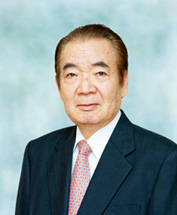
| Biography |
In 1982, he founded the International Highway Construction Agency in Tokyo to specifically promote the International Highway Project and the Japan-Korea Tunnel Plan, and served as its chairman. |
|---|