The Road to Peace: Global Environmental Systems Design (Building an Autonomous Decentralized Control Society)
Chairman of the World NGO Peace Ambassadors Council
Katsuyuki Kawaguchi, Chairman of the Nagasaki Council for the Promotion of the Japan-Korea Tunnel
We have entered an era of extreme specialization, making it difficult even for experts to make broad-based judgments. It is precisely at times like these that we must integrate . I have discussed a methodology for solving problems (such as inequality and poverty) through "collective intelligence" using general-purpose artificial intelligence (big data). The key is building an autonomous, decentralized, controlled society. In this era of "competition" between land-based and maritime nations, let us finally consider the optimal design (collaboration) of the component technologies. The "worst-case scenario" for Japan would be for Russia and China to form an alliance and direct their artillery toward the Japanese archipelago. Despite the Ukraine issue, it would be unwise to block escape routes and ultimately force Russia and China into an alliance. We must begin the development of Eurasia, the world island, with the aim of global "collaboration."
First, to cultivate the "sensitivity and bodily knowledge" that will help us to avoid mistaking our starting point and direction, we must make people acquaint themselves with "science and technology as a real experience." This will give them the potential to awaken the images of "awareness, discovery" and "creation."
While Amory Lovins of the Rocky Mountain Institute has commented on Japan's use of distributed energy as an alternative to nuclear power, the failure of the Ministry of Economy, Trade and Industry's policy of "profiting from finance rather than industry" has left the country at the bottom of the developed world. Japan's installed capacity from distributed energy sources is one-ninth to one-tenth that of Germany. However, its resource stock is nine times that of Germany. Japan's forest area is the third largest in the world, and thanks to this, delicious seafood is harvested off the coast of Japan. However, biomass power generation is virtually nonexistent. Furthermore, despite being a water-rich country, Japan has yet to establish production methods suitable for Japan that can store energy, such as pumped hydroelectric power generation. Furthermore, despite Japan having some of the world's largest geothermal energy resources and capable of steady-state operation, the Ministry of Economy, Trade and Industry (METI) is only promoting nuclear power, which has a low utilization rate. Furthermore, Japan has not addressed issues such as optimal insulation and refrigerant structures, rooftop solar panels, heat pumps, and other aspects of urban building design, preventing heat land, and designing compact cities for optimal living. Amory Lovins points out that this is because the postwar monopoly system of energy production and sales by nine electric power companies has denied competition and prevented widespread adoption.
In "The Age of Great Disasters," Iokibe Makoto says that recent "earthquakes" are the same as "national crises" such as the Mongol invasions of 1288. If the national crisis is caused by human activity, there is a possibility of overcoming it. Humans have not truly grasped the "transition of history." Humans want to be "lions standing in the wind." For example, when we look at the economy, no one realizes that when profits reach saturation, the flow of money becomes a nonlinear phenomenon and traditional economic laws no longer hold.
The United States, which had adopted a policy of respecting "management," further shifted to a system of "making money through financial economics rather than industry," and became a society centered on stock profits, with physicists counting money on Wall Street. As a result, more than 5 million manufacturers disappeared. In ordinary banks and investment banks, financial, economic, and investor interests all engaged in the same "money-making" activities, and there was no one who could judge from the outside whether the strategies they adopted were correct. Everyone died of the same illness at the same time. This was the economic collapse of 2008.
In short, all "collecting" became the same environment, the autonomous decentralized control stopped working, and it collapsed. Beyond the intentions of the parties involved, everyone became like "Shylock" from Shakespeare's Merchant of Venice, and everything led to a new era.
Profits have saturated, and the modern growth system has become dysfunctional. Why is it that as soon as we give up on the Monju prototype reactor, a complete disaster, a more advanced demonstration reactor is revived? They have no understanding of the hierarchy of technology. This is the way politicians and bureaucrats who have no real understanding of science and technology always act. We are nowhere near the "lost 20 years," let alone escaping deflation. They are blinded by neoliberalism and refuse to acknowledge the problem as a problem. The "only way" is to develop the final economic frontier, Eurasia, the heartland.
It is a natural conclusion from the discussions so far that Japan should aim to create an autonomous, decentralized, controlled society based on distributed energy systems similar to those of living organisms. Specifically, we will summarize the optimal design and development themes that form the core of global environmental systems design theory. This is an urgent and eternal theme that must be tackled on a global scale.
▶To let elementary school students experience the fact that Japan is a country prone to natural disasters, we will send them on "experiential learning" trips to disaster sites. The budget will be cut off from English education. There is no need to make "children" learn a language that teaches "losing is winning" and has no concept of "mono no sadness."
This allows children to see what a destroyed house looks like and what an undestroyed house looks like, and to experience the benefits of intelligent design and education. This is an experiential learning experience that will help prevent children from losing interest in science and technology and contributing to poverty.
▶Application of Japan's proud shield tunnel excavation technology - Development of disaster prevention and safety design technology
The technology to safely excavate tunnels can also be used to create evacuation centers, shelters, underground societies, waterways, and supply routes, and if used properly, can also be a tool for social development and a route for disaster prevention and regeneration.
The sublimity of Mt. Fuji and energy production - power generation and disaster prevention through venting volcanic gases
The dream is to harness the beauty and spirituality of Mt. Fuji and the power of its magma. If it were to erupt, the damage would be immeasurable. The main objective of the design is to "prevent and reduce the frequency of eruptions" in the volcanic mountain eruption system, and we propose using the erupted gases to power a "cogeneration gas turbine" or, if it were steam, to generate "geothermal power," thereby creating a long-term regional revitalization model of "energy production and the preservation of cultural heritage through increased safety."
Japan's "shield tunnel boring technology" is the best in the world. By using monitoring and this "shield tunnel machine," work can be done with a high level of safety.
China's land-sea energy corridor has begun construction. A Japan-Korea tunnel should be built as the "core" of the path to "cooperation" between land and sea nations. Economics, which assumes that "someone else makes the decisions," can make us victims, not responsible. Decisions should be made through intelligent design (optimal design theory), based on truth and self-determination. Japan must respond to the rampant anti-intellectualism and hate speech around the world with the "sensibility" of the "sublimity of Mt. Fuji." This is nothing other than "the sensitivity and acceptance of the pathos of things, the universal principle of impermanence, and the love and creativity that arise from it, and the denial of regrets." The sublimity of Mt. Fuji swallows such things. This is the spirit of Nagasaki, the city of the atomic bomb, the city of peace, and the city of prayer.
In other words, through the "construction of a Japan-Korea tunnel through collaboration between the peoples of Japan and Korea," we must mutually improve ourselves and set a direction for building an "autonomous decentralized control society" on Earth.
Heartland energy production, distribution, and circulation will be carried out through joint development with Russia, China, and Mongolia. The means of this will be energy management, which will be described later. Gas/oil will be converted into a distributed energy system that does not rely on nuclear power by constructing a pipeline to Hokkaido via Sakhalin.
Which is smarter: building a ship, hiring people, and transporting heavy oil from the Middle East nearly halfway around the world, or instantly delivering electricity using electricity? In Japan, a power semiconductor (SiC) has been developed and put to practical use, which significantly reduces losses in high-voltage power transmission*.
The southwestern part of the Japanese archipelago will be connected to Kyushu via Tsushima and Iki, via a smart grid that will share electricity produced by the East Asian power grid (distributed energy, wind, solar, hydroelectric, tidal, biomass, etc.) with each country via the Japan-Korea Tunnel. Technically, this is called an energy management system, but it is equivalent to an autonomous decentralized control system, a brain that manages energy consumption, production, and distribution according to the environment and time of year.
It implements comprehensive energy management by optimally designing load leveling (peak power cuts) and energy conservation for the entire distributed energy system and in response to local demand. The system collects data on seasonal and regional fluctuations in household power consumption and gas consumption, devises annual demand forecasts, and transmits and distributes electricity. An example of an energy management system equipped with power storage in sodium batteries and lithium-ion batteries is shown in Figure 12.1.
Respond to fluctuations in wind and solar power output with a variety of distributed energy sources and implement optimal design. Install storage batteries and store surplus electricity in batteries on the demand side, on the grid side. Charge the batteries with electricity during the night and use that electricity, along with wind and solar power, during the day.
Applying this type of autonomous decentralized control mechanism, the northern part of Japan could see the circulation of energy through a "pipeline" that would carry natural gas or oil obtained through joint development in Siberia through southern Sakhalin to Hokkaido, and the establishment of a utilization line for that energy. The most promising corridor in the south would be to capture the winds of the Gobi Desert in southern Mongolia, generate wind power, and distribute the electricity to Kyushu via a Japan-Korea tunnel.
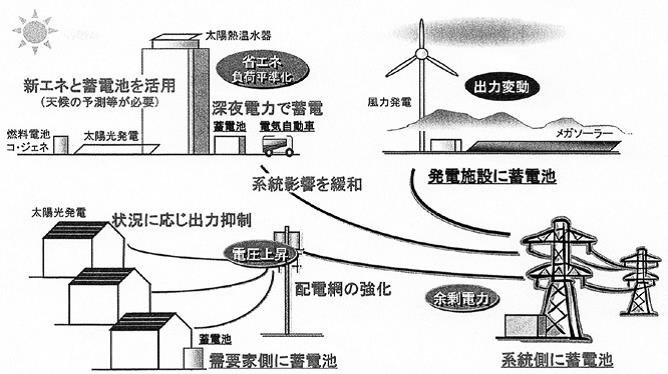
Figure 12.1 Energy management system, design of production, distribution, and transportation according to region and environment
Partially modified quote (Watanabe 2010)
According to SoftBank's estimates, even excluding the windless Gobi Desert, it would be possible to generate 7-10 million kW of electricity, equivalent to the power of 7-10 nuclear power plants. The cost of wind power generation in Mongolia is 2-3 yen/kWh, and even including the cost of grid transmission to Japan, it would be less than 10 yen/kWh, making it cheaper than nuclear power or other forms of power generation. Japan's electricity rates, which are the highest in the world, would be reduced to below those of the United States, solving the CO2 problem and maintaining economic growth and employment.
Heartland energy production involves a distributed energy utilization system, so it also includes the development of distributed energy equipment. It goes without saying that distributed energy production is more productive than centralized energy production, but nuclear power and steam turbines use large amounts of water as their working fluid, making them unsuitable for rough terrain, while gas turbines, diesel engines, and gas engines are more suitable. These prime movers are approaching their practical limits of design, so it goes without saying that an optimal management system for natural energy and distributed energy is essential.
During the Great East Japan Earthquake, I proposed to the government a technology for efficiently producing and consuming locally produced electricity and heat through the Nagasaki method of high-calorie gasification power generation, which would utilize the wood that made up 70% of the rubble, and apply rubble processing and cogeneration gas turbines.The high-calorie gas produced by this method is primarily hydrogen, carbon monoxide, methane, etc., and significantly reduces fuel consumption (for details, see "Research into the Expression of Inner Human Sensibility," pp. 417-422).
Current hydrogen production involves extracting hydrogen from fossil fuels through aqueous reactions, but this does not reduce carbon dioxide emissions. The most sustainable method is to produce hydrogen through water electrolysis using solar and wind power. The Bush administration's approach to extracting fuel (ethanol) from food (corn) involves alcohol fermentation, which is inefficient. Therefore, efficient fuel production from food waste is a divinely designed intelligent solution. The high-calorie gases (H2, CO2, and CH4) used in high-efficiency power generation and cogeneration gas turbines are residues generated by agriculture, fisheries, forestry, and their service industries. Figure 12.2 shows this cycle of energy production and consumption. The diagram also illustrates the Nagasaki method of high-calorie gas production. Simply applying a small amount of pressure to high-calorie gas and passing it through a catalyst produces methanol (a liquid fuel similar to hydrogen) (see "Research into the Expression of Human Inner Sensibility," pp. 417–422, for details). Half the dry weight of biomass can be converted into methanol fuel. This can be used as a mobile fuel and will mark the beginning of the hydrogen era.
"A chain is only as strong as its weakest link, and life is nothing but a series of chains"
William James
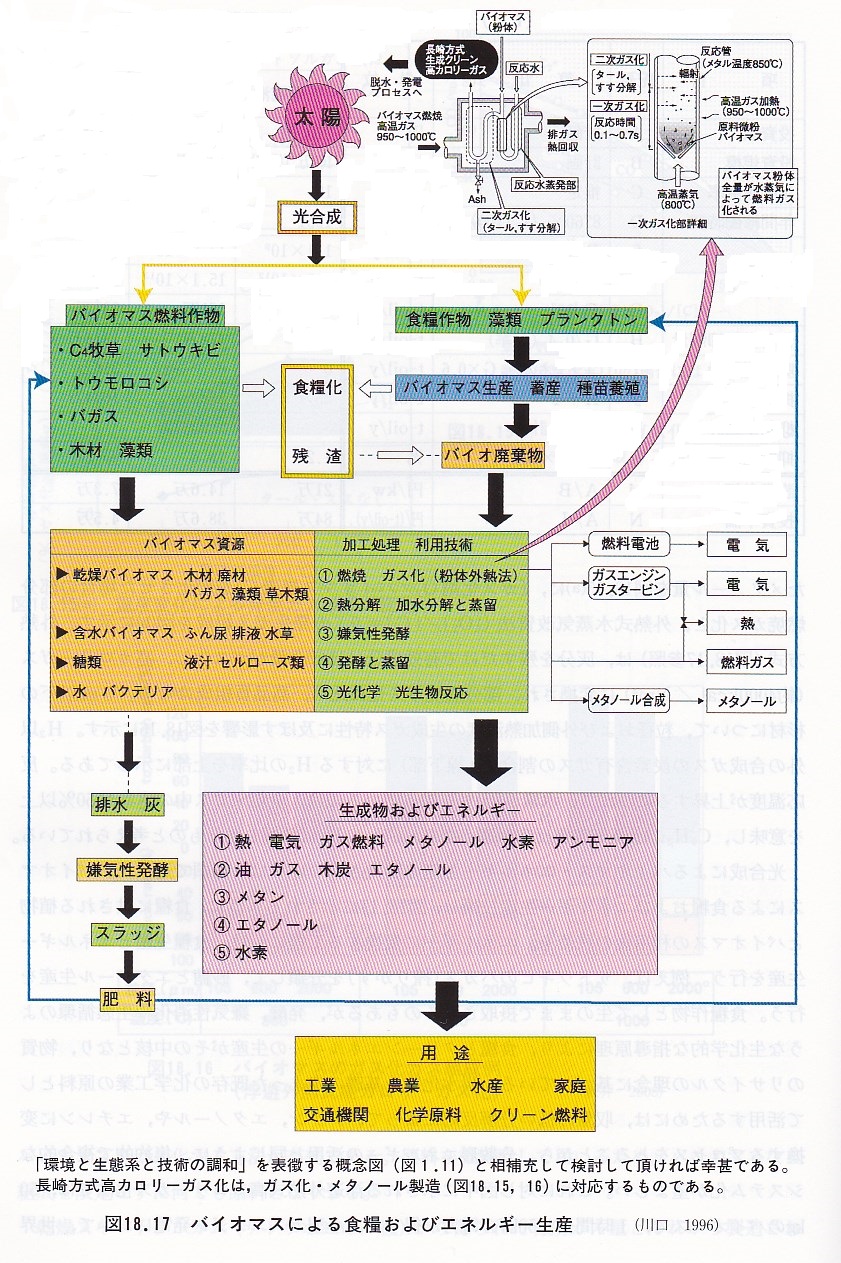
The arrow indicates the Nagasaki method of high-calorie gasification production. All biomass powder is converted into high-calorie gas (H2, CO, CH4) using high-temperature steam.
Figure 12.2
(From a study of the expression of human inner sensibility)
"The Earth's History of Extinction," by Sawano Masaki, published by Kodansha Sensho, is a stimulating book that treats the history of the Earth from the Big Bang to the present day not as natural science but as history and the humanities.
The 21st century is an era in which human activities are bringing about decisive changes in the historical state of the global environment. Long before that time comes, the Earth will come to an end due to human foolishness.
If we make the wrong choice at the crossroads we are now facing, we will head down the path to destruction. That is how dangerous what humans are doing now is to the fate of the Earth.
The time has come for the United States, the world's most influential nation, to begin discussions with the world's intelligent designers about solutions to the excesses of globalization—namely, cooperative protectionism rather than competitive protectionism. It is also necessary to figure out how to train workers to fill the jobs that will be left vacant by the disappearance of manufacturing.
According to Professor Nakanishi Hiroshi of Kyoto University, the recent history of the Earth has shown that intelligent people , who believe that their calculating reason can control the emotions and social order of other people, is a "deadly conceit," just like the "grand narratives" of the past. The world is likely to face the biggest challenges since World War II.
There is nothing more frightening than assumptions. "What was once impossible and unrealistic is now possible." The world's common sense is changing. "In order to do what is right, you must know what is true," Huxley and Kosuke Motani assert.
The problem is that accurate understanding of the facts has not spread throughout the country, and so no appropriate response has been taken. This is the prelude to the "Earth History of Extinction."
To put it in emotional and technical terms, it brings to mind Agatha Christie's "And Then There Were None," which I read as a boy, and creates an image of each person disappearing one by one.
(2016.12.10)
Cited references
(1) Katsuyuki Kawaguchi, "Global Environmental Systems Design Theory" (revised and expanded edition), Kyushu University Press, 1996
(2) Katsuyuki Kawaguchi, "Research on the Expression of Human Inner Sensibility" (revised and expanded edition), Creative Design Society, 2010
(3) Michiru Nishigaki, "The Form of Knowledge Created by Users" Deepening Collective Intelligence, Kadokawa Gakugei Publishing, 2015
(4) Eisuke Sakakibara and Kazuo Mizuno, "The End of Capitalism and the World Beyond," Shisosha, 2016