The concept of the ``International Highway Project,'' which aims to connect Tokyo to London with a high-speed transportation network, was proposed at the 10th International Conference on the Unification of Sciences (ICUS) held in Seoul, South Korea in November 1981. It is something that
This concept originally existed as a transcontinental railway since the days of the former National Railways (Ministry of Railways), and is a huge project that crosses national borders, and is also the largest project in human history spanning the 20th and 21st centuries.
Valuable data has been accumulated as a result of surveys and research over the past 10 years.
Our country has completed major projects such as the Seikan Tunnel and the Seto Ohashi Bridge, but this wisdom should not be used only for the benefit of the Japanese people, but for the improvement of the welfare of humanity as a whole. It appears to be. Today, humanity has ended the Cold War between East and West, and is moving away from war and toward peace.Moreover, we have entered an era of global thinking, and Japan's national policy has become ``international contribution'' the basic policy. Looking around the world, European integration has taken place in Europe, and the Strait of Dover Tunnel connecting Britain and France has been completed (starting operations in 1994). Isn't it time for our country to make humanity's dream of "going from Tokyo to London" come true?
First, if we look at the effects of development and the aims of the project, we can think of the following specific things.
By establishing an international order based on the high-level values of humanity, we can avoid huge economic waste and loss of resources.
Exchanges of people, goods, and culture (high-speed transportation systems, communication networks using optical fiber cables, etc.) will become smoother, the leveling of technology and industry will be promoted, and this will contribute to the balanced development of Asia.
Effective use of energy (electricity, etc.) and resources (natural gas, water, etc.) becomes possible.
This will be a major stepping stone to the formation of an East Asian community (Japan, South Korea, China, and Taiwan have a population of 1.4 billion).
・The East Asian region has diverse and abundant human and material resources, and by improving transportation facilities, it is possible to create a powerful economic zone. At that time, Japan, South Korea, and northeastern China will play a central role as industrialized countries.
It will help revitalize the world economy.
It will be possible to further improve the technical know-how accumulated from projects such as the Seikan Tunnel, the Honshu Bridge, and the Tokyo Bay Crossing Road, and contribute to large-scale projects around the world.
For example, by connecting not only the Japan-Korea tunnel but also the Soya Strait and Mamiya Strait with an undersea tunnel, it will be possible to realize a trans-Japan Sea transportation network.
The construction of the Japan-Korea tunnel will create long-term demand for employment and materials, which will have a huge economic effect on the relevant regions, helping to stabilize the economy and resolve economic friction.
In Japan, a new comprehensive plan called the Second National Land Axis Concept is being developed. Northern Kyushu is where the traditional first national axis (Tokaido/Sanyo Expressway) intersects with the second national axis (Tokyo, Ise Bay, Kii Peninsula, Kitan Strait, Shikoku, Toyo Strait, Kumamoto <Nagasaki>). By connecting there with the Korean Peninsula, cooperation with the continent can be established. Many projects are being planned in the Chugoku, Shikoku, and Kyushu regions, and by linking this east-west domestic axis with the continent, it will intersect with the north-south international axis .
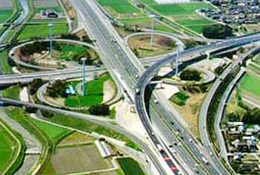
*From Tosu Junction “Saga Prefectural Office” website
an analysis of trends in transportation methods in Japan , truck transportation accounts for the majority of logistics.
While air route logistics handles urgent goods and expensive long-distance goods, and sea route logistics handles bulk cargo (large cargo), we will be in charge of the logistics of processed trade goods in the coming new era of Japan-Korea horizontal division of labor. The main means of transportation is likely to be trucks. Regarding the flow of people, while air routes are predominant over long distances, trains account for most distances between 500km and 700km, and cars account for the majority within 500km.
Centered on the Tosu Interchange the most important point for land transportation in Kyushu centered on Tsushima in the figure ) covers almost all of South Korea and western Japan.
The traffic demand for the Japan-Korea Tunnel, which will run through the center of the circle, will probably consist of rail and container (or truck) transportation for logistics, and high-speed rail (or automobile) transportation for people. Furthermore, a large-scale project that is located within the 500 km radius mentioned above and has mutual influence with the Japan-Korea Tunnel is considered. International highway routes within Japan should be considered in the future, taking into account coordination with the existing transportation system and new land uses that are consistent with the lifestyle of the next century (already, the second Construction of the Tomei/Meishin Expressway has begun). Here, when formulating a development concept for Japan-Korea tunnel-related areas, the basic policy is to clarify the roles and functions of each area, and to link them with existing development plans, so as to increase international synergy effects. It is necessary to take into account.
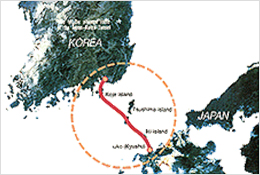 A project aims to have a direct or indirect impact nationally or internationally.
The Kyushu-Itsushima Strait Tunnel (bridge), which is a domestic issue, can be considered as a concrete measure to revitalize the culture and economy of Kyushu and the Sea of Japan regions. In particular, the aim is to greatly contribute to the resolution of other remote island issues, including the northern Kyushu region, Iki, and Tsushima. Depending on the weather conditions, remote islands can be difficult to access, causing great anxiety in daily life in a broad sense, and this is similar in some respects to the factors behind the Seikan Tunnel Project. The only way to solve this problem is to secure a complete traffic route, and the only option is to build bridges, undersea tunnels, or undersea tunnels.
As an international issue, the ``Tsushima-Korea Strait Tunnel'' is envisioned as creating an organism with culture, politics, economy, etc. through mutual solidarity based on characteristics by adding the continent, the Korean peninsula, and Japan, and revitalizing economic activities and creating a broader settlement. It is hoped that this will improve the environment and have an impact on building lasting peace in the East Asian region. Regarding the construction project itself, there are two parts: a domestic issue and a bilateral issue. Regarding undeveloped technologies related to construction, technology transfer will be promoted, and joint ventures may be considered in some cases. Since the Kyushu-Itsushima Strait Tunnel (bridge) project is a domestic issue for Japan, I believe that it should gradually seek a wider range of participants, form a promotion group, and move forward with national consensus. The objective objective is to unite not only the mainland and remote islands, but also Japan and the continent, and create a community of values based on the common values of mutually protecting freedom, human dignity, and the rights of each nation. It seems to be assumed that it will be possible to build.