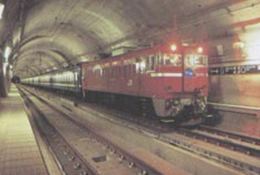
* Seikan Tunnel
Because this tunnel is positioned as part of an international highway project, the most desirable driving method is for automobiles to be able to drive themselves. Therefore, this must be considered first. Many automobile tunnels have been built in Japan to date, but the size standards for these tunnels have now been largely finalized, as shown in Figure 1. When traffic demand is below 10,000 vehicles per day, a single lane will be used for both inbound and outbound traffic. When traffic demand increases, another identical tunnel will be added, with two lanes in each direction. Furthermore, because this
is an undersea tunnel, pilot tunnels and service tunnels will be required. Based on the example of the Seikan Tunnel, it is likely that these will be constructed in the layout shown in Figure 2. Pilot tunnels and service tunnels will be used for ventilation and pipelines even after the tunnel opens, as well as for maintenance work. Regarding the Japan-Korea Tunnel, joint management of facilities such as optical fiber cables, superconducting electricity transport facilities, natural gas supply facilities, and drinking water transport in the face of future global warming issues is also considered.
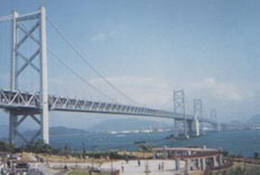
* Honshu-Shikoku Bridge
However, the biggest problem in this case is ventilation. Because automobiles emit exhaust fumes, long tunnels require large-scale ventilation equipment. shows the ventilation equipment for the Kan'etsu Tunnel, built by the Japan Highway Public Corporation the ventilation equipment for
the Eurotunnel and the Tokyo Bay Crossing Highway This ventilation system uses a vertical shaft ventilation system, which is slightly less expensive to build than a horizontal system.
However, the Japan-Korea Tunnel is several dozen times longer than the above-mentioned tunnels, so the ventilation equipment costs would be extremely high. Another crucial disadvantage is that, because it is an undersea tunnel, no vertical shafts or inclined shafts can be built. The total ventilation volume required varies depending on traffic volume, but 1,000–2,000 m3/s is required. In land tunnels, vertical shafts are installed every 1–2 km to supply and exhaust air from above ground. Assuming a total length 20 times that of the Kan'etsu Tunnel and three times the fan horsepower per unit length, the electricity costs alone would reach more than 10 billion yen per year, making this an unrealistic plan.
 All methods of autonomously driving vehicles through tunnels pose various challenges. However, as the tunnel is expected to open in 20 to 30 years, it is anticipated that a new intelligent transport system (ITS) will be developed during this time that will enable autonomous driving within tunnels. Furthermore, the practical application of current-collecting electric vehicles is also conceivable as a fairly realistic use. However, tunnels are enclosed spaces, and manually driving them for long periods of time is difficult due to psychological pressures and other factors.
 Therefore, while driving in tunnels needs to be automated, completely unmanned operation is not necessary. Since people are currently in the vehicles, the automated driving system only needs to be able to assist the driver and coordinate with their movements. Therefore,
tunnels will need to be designed with ergonomic considerations, such as an automated highway system (AHS) and the layout of lighting and traffic signals. Therefore, the simple current-collecting vehicle guidance system mentioned earlier will be one support for automated driving. In addition, the introduction of guideway signal safety equipment to prevent front-to-rear collisions will also be necessary. Another
issue is that while Japan drives on the left side of the road, Korea drives on the right. Under domestic regulations, vehicles traveling through the Japan-Korea Tunnel must naturally drive on the left until they reach Tsushima. Therefore, a change of direction will be necessary somewhere between Tsushima and Geoje Island. If customs clearance procedures are carried out at any point, that point will be the changeover point. At this point, all vehicles stop and passengers disembark, making it easy to change sides. However, if the current system of free border crossings, as is common in European countries, were to be implemented, a turning point using an overpass would have to be created somewhere. In that case, drivers would have to be made fully aware that the two sides have been reversed, and every possible measure would have to be taken to prevent accidents.
There have been many successful examples of running railways through long tunnels. The Seikan Tunnel, is 53.85 km long. The Japan-Korea Tunnel is 250 km long, connecting the islands of Iki and Tsushima. In this case, due to the linear relationship between Iki and Tsushima, the tunnel would likely remain underground, preventing access to the surface. However, this would be the same as an underground tunnel on land, and the longest underwater section is approximately 70 km from Tsushima to Geoje Island. Therefore, if we extrapolate the experience of the Seikan Tunnel and build a railway tunnel, there would likely be fewer technical problems. Figure 4 shows the cross-section of the Seikan Tunnel , which was constructed to Shinkansen standards.
It would be preferable for the Japan-Korea Tunnel to be constructed to roughly the same standards. If excavation is done mechanically, such as with a tunnel boring machine (TBM), the tunnel cross section will be circular, as shown in Figure 5. However, as will be discussed later (the introduction of the French-made TGV was not intended at the time of the study, and future studies will compare it with this TGV ), the vehicle clearance for direct trains to Korea will be slightly smaller than that of Japan's Shinkansen, so the tunnel cross section can also be slightly smaller. There is also the possibility of Japan's Shinkansen running all the way to Busan, and the vehicle clearance for Korea National Railways above the platform area is roughly the same as that of Japan's Shinkansen.
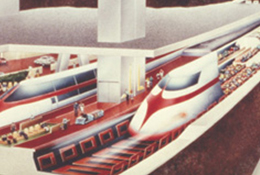 Therefore, the tunnel cross section shown above is likely to be used. Since the tunnel section will naturally be an electric track, overhead lines will be required to supply power, as shown in the cross section. The trains will be Shinkansen trains, so the electrical system will be 25kV AC. Therefore, substations with a capacity of approximately 30,000kVA will be required every 20-30km. Furthermore, depending
on the progress of the experimental Yamanashi Linear (Maglve) Line (see: Future Japan-Korea Tunnel Concept Diagram), it is likely to have a significant impact on the advanced transportation network between Japan and Korea, and throughout Northeast Asia. Regarding the
Linear Motorcar, the "Superconducting Magnetic Levitation Railway Practical Technology Evaluation Committee," composed mainly of academic experts, evaluated the system at its 8th meeting (2000) as "Although there are still some issues to be considered regarding long-term durability and economic viability, it is believed that the technical viability for practical use as an ultra-high-speed mass transit system has been achieved." To address issues such as long-term durability, cost reduction, and vehicle aerodynamics, test runs aimed at practical application are scheduled to continue for approximately five years after 2000 on a pilot section (reference: Ministry of Land, Infrastructure, Transport, and Tourism, "Linear Motor Car" website).
Because the Seikan Tunnel is 54 km long, substations are installed on both sides of the tunnel to supply power. In the case of the Japan-Korea Tunnel, substations are installed on land on each side of the tunnel between Kyushu, Iki, and Tsushima, allowing power to be supplied to the tunnel. However, the underwater section between Tsushima and Geoje Island stretches for 70 km, necessitating the installation of one or two intermediate substations. This requires securing a space of approximately 20 m x 15 m x 30 m on the seabed and laying high-voltage cables to that point. Furthermore, if a railway is built, passengers will travel through the tunnel, eliminating the need for a terminal (however, with the introduction of the French-made TGV, differences in signaling and control systems exist, and interoperability is a topic for future consideration).
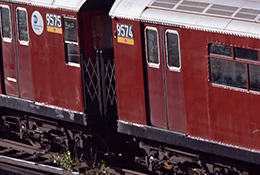 Regarding freight transport, if the Japan-Korea Tunnel were to connect domestic Korean railways with the Shinkansen, both the Shinkansen and domestic Korean railways (including TGVs) would use standard gauge (1435mm), allowing freight trains to travel directly to any destination within Korea. However, Japan's Shinkansen was designed for passenger transport only, making it difficult to transport general freight. Conversely, access to Japan's conventional railways requires narrow gauge (1066mm), making direct service impossible. Therefore,
container transport will be the primary mode of transport, and a container transshipment base will be established on the Kyushu side. This requires a fairly large transshipment base, and one option is to use surplus rail freight facilities in the Chikuho coalfield.
Here, containers loaded on Japanese freight cars will be transferred to freight cars bound for Korea. While transshipment of containers between rail freight cars is rare worldwide, the practice of international freight at the Spain-France border is a good example. In addition, containers bound for Korea transported by truck from northern Kyushu and western Chugoku region will be transferred onto container freight cars at this base, and vice versa. From the perspective of cargo transport alone, it will be as if the Korean railway has been extended to the base in northern Kyushu. It is not appropriate to transport large bulk cargo (coal, cement, ore, grain, etc.) by rail through the Japan-Korea Tunnel. Considering that large cargo is now being transported domestically by coastal shipping, the same approach will apply to transport between Japan and Korea.
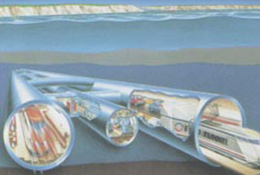 Railways generally also allow automobiles to be transported on freight cars. Therefore, automobiles can be loaded onto the railway for the tunnel section and then driven to their destination once they exit the tunnel. The train
(Le Shuttle) operating through the Channel Rail (EuroTunnel) uses a car train system in which automobiles are loaded onto two freight cars
(sometimes one for large vehicles) passengers generally ride in the passenger cars. Passenger cars are loaded and unloaded from the freight cars by staff, who drive them themselves. Car sleepers are commonly used in Europe. In this case, passengers sleep in sleeping cars, arrive near their destination the next morning, and then drive themselves from there. This same system applies to tunnel transit.
Of course, since railways operate through-services, they can be extended beyond tunnels to longer distances, using sleeping cars.
Freight cars can also be transported by rail in a similar manner, but only within tunnels. However, when large freight vehicles are loaded onto regular freight cars, they often exceed the vehicle limits, so methods such as using the freight cars as the floor or lowering only the wheel section under the floor, such as kangaroos, are used. When loading cars onto freight cars, a parking space is inevitably required for waiting. This can be called a ferry terminal.
The space required varies depending on the volume of freight, but it requires 200 to 300 passenger cars, or an area of 10,000 to 15,000 m2. In addition, facilities for passengers and freight vehicle crews to rest are required. This is similar to a service area on a highway.
The South Korean government plans to build an expressway connecting Busan and Geoje Island (total length: 8.2 km), with completion scheduled for 2009. The project will consist of two cable-stayed bridges, each 230 m and 475 m long, and a 3.4 km immersed tunnel 40 m below the surface.
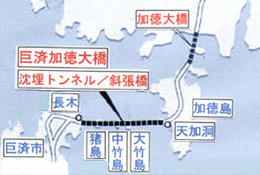 The groundbreaking ceremony for the Geoga Bridge, a connecting road linking Gadeok Island in Busan with Geoje Island in South Gyeongsang Province (Gyeongnam), was held in front of the Busan New Port Public Relations Center on November 27, 2003.
A total of 1.4469 trillion won (approximately 144.7 billion yen) was invested in the project by 2010.
The 8.2km road, with four lanes in each direction, connects Cheonga-dong, Gadeok Island, Gangseo-gu, Busan, with Yuho-ri, Changmok-myeon, Geoje, South Gyeongsang Province.
The 3.7km section from Gadeok Island to Daejuk Island will be constructed using an immersed tunnel, a first in Korea, where a structure is built on land and then anchored to the seabed. The 4.5km section from Daejuk Island to Jungjuk Island to Indo Island to Jangmok will be constructed as two cable-stayed bridges.
The construction project will be led by GK Marine Highway, a consortium of eight Korean companies, including Daewoo Engineering & Construction, Daelim Industrial, and Doosan Engineering & Construction, with a total investment of KRW 999.6 billion. The government, Busan City, and Gyeongnam-do Province will provide KRW 447.3 billion in support. Upon completion, the road will belong to Busan City and Gyeongnam-do Province, but will be managed and operated for 40 years under the Build-Operate-Transfer (BOT) model, under which the contractor will collect tolls and manage and operate the road. Once
opened, the road will reduce the distance between Busan and Geoje from 140 km to 60 km and travel time from 2 hours and 10 minutes to 50 minutes. It will also help distribute traffic on the Namhae Expressway and Gyeongbu Expressway, significantly facilitating the handling of imports and exports for the Busan New Port, Mongsan-Sinho Industrial Complex, and Geoje's shipbuilding industry. Prior to this, in October 2003, Busan City held a groundbreaking ceremony for the construction of the Gadeok Bridge, part of the Busan-Geoje connecting road, and began construction.