Chairman of the World NGO Peace Ambassadors Council
Katsuyuki Kawaguchi, Chairman of the Nagasaki Council for the Promotion of the Japan-Korea Tunnel
How can we make this major national project a success?
Democracy and capitalism have always been a good match. Until now, all that was needed was to distribute profits. However, we are now in an age where a change in mindset is required. We must create a "national century-long plan" that excites young people, like the Meiji Restoration, and by carrying it out, we can improve ourselves, and by making full use of the brain's information control mechanism, intelligent design (optimal design theory) based on "autonomous decentralized control," we can design the best "system" for world peace and "production and consumption." This is the essence of "Global Environmental Systems Design Theory."
Perhaps this will be a solution to the current economic order that is destroying the environment and the profit-first mentality that has led to the declarations of a global crisis by Queen Elizabeth and the Pope. It will be an orderly solution that transcends economics and integrates religion, art, science and technology. Ultimately, this requires a "complex adaptive systems" approach based on the finite nature of human beings.
Democracy has been said to be a universal form of government, but recently there has been a lack of common understanding of what constitutes the fundamental principles of democracy.
As Emmanuel Todd has said, a sense of unity or solidarity such as "We the People" no longer exists, and diversity, especially disparities, are becoming apparent among citizens. In other words, there is a "complexification of society."
This is a completely different type of politics from a winner-takes-all system, and democracy is required to create rules and maintain order within these complex differences. Democracy was
once compatible with capitalism, but how will it transition in a complex society, especially in a situation where the "inequality" that fosters corruption is widening? From the
perspective of sensory technology, since there have been almost no successful examples of large-scale national projects to date, I have come to believe that the basis of modern democracy is not to get the government to do good things, but to prevent it from doing bad things. This would allow opposition parties to function as well.
According to Professor Masatoshi Mori of the University of Tokyo, the political system of the 20th century was premised on economic expansion. Neoliberalism has long maintained that capitalism develops through the vitality of the private sector, but is it possible to pursue capitalism's economic frontiers indefinitely? The Earth is not infinite, and the human lifespan is also finite. The final economic frontier is Mackinder's heartland development.
Efforts to restore democracy through economic expansion policies have reached a dead end. Meanwhile, the private sector is making many efforts but is unable to do it alone and is seeking political assistance. From this perspective, we should address complex adaptive systems through intelligent design (optimal design), which involves solving each and every problem one by one. Surprisingly, university researchers and developers themselves have tackled this problem and presented examples of successful solutions in "Perspectives" I, II, and III.
We must be aware that there are problems that cannot be solved by democracy. It is difficult to reconcile nuclear power and democracy. If humans cannot survive without nuclear power, then the idea that nuclear power is superior to democracy is valid, but it would be difficult for anyone to actually take such risks in defense of nuclear power.
It is difficult to define who needs to support nuclear power plants. It is not enough for local residents to support them; if an accident occurs, the damage will extend beyond the local government where the plant is located, and the harm can even cross borders.
Nuclear power plants face the problems of not disclosing information, which is essential for democracy, and are vulnerable to terrorism. In other words, the democratic idea of implementing what we decide is reaching its limits. The solution to the energy problem (nuclear power problem) can be achieved by combining research and development into new energy sources with existing decentralized energy sources and intelligent design (optimal design). To achieve this, it is essential that global society becomes an autonomous decentralized energy society. The question is whether a consensus can be reached on this through democracy.
Global society is made up of many complex elements, and destroying any one element will disrupt the whole . Because our world is so fragile, it is necessary to address each element one by one using the Japanese concept of "mono no aware." A typical example is "children and poverty."
Emmanuel Todd conducted a demographic analysis of infant and child mortality rates, and, taking into account geopolitical and anthropological considerations, predicted the collapse of the Soviet Union.
Watanabe Kyoji (Remnants of a Bygone World, Heibonsha) has a sharp eye for observing Japan.
Foreigners who came to Japan from the end of the Edo period through the Meiji era were apparently amazed by the sight of Japanese children running around the streets, making a lot of noise from morning until night. Their happy expressions, running around frolicking in the middle of every street, were enough to make them lose interest in traffic and were completely absorbed in their play. In fact, adults were careful not to disturb the children's play.
Those were the "good times," when the sounds of children playing echoed throughout the town. Japan's rapid growth since then is a convincing confirmation of the paradox of Emmanuel Todd's prediction. He is saying that what is important is not the death rate, but "birth rate and education."
From now on, this will be described as a "side benefit," but for the past hundred years, we have become a generation where the sounds of children playing in the streets are met with complaints from residents that they are too loud. A Tokyo Metropolitan Government survey found that 70% of wards, cities, towns, and villages received complaints about the sounds of children playing in daycare centers and parks. In this climate, people only demand economic growth from the government. Economic growth is a "certain order" that arises from "synchronization" with others. Let's return to the tolerant Japanese who are "synchronized with others," as Lafcadio Hearn and other foreigners of the past pointed out. Otherwise, we should realize that economic growth is uncertain. As I write this, the sound of children gathering together, which I often hear from the park in front of my house, sounds like a Buddhist mantra...
The best solution to this problem is to design a system of environmentally friendly jobs for the elderly (knowledge work, agriculture, leisure, sports, etc.). This will also lead to reduced nursing care and medical costs. A
national long-term plan requires the "purity" and "vitality" shared by young people. Without this, nothing we do will "successfully" succeed, and we will be unable to lead collective synchronicity like the "fall of the Berlin Wall." The elderly should then "collaborate" with young people by providing the "knowledge and intuition" they have accumulated through their "experiential learning."
As shown in Figure 5.1, humans experiential learning . When we encounter truly new situations, we tend to quickly pretend to understand them by thinking in the same way as before or as an extension of that thinking, but in reality we are running away. If we cannot properly grasp the newness of the history before our eyes, we will not be able to create the history of the future.
The elderly share the fruits and failures of their own "experiential learning," while the young take care of the elderly with their vigorous "vitality" and "energy for action." Is it possible to live a life of "collective intelligence" like this mutual learning "cram school"?
For example, in the online space of "open science" described in a later chapter, we will consider the important requirements for the effectiveness of online collective intelligence, in which the elderly and children teach and are taught their skills. The most interesting applications of online collective intelligence are in areas where, at least on the surface, no objective standards of evaluation exist, and they arise from orderly free discussion, such as the merits and demerits of restaurants or the latest trends in movies and music.
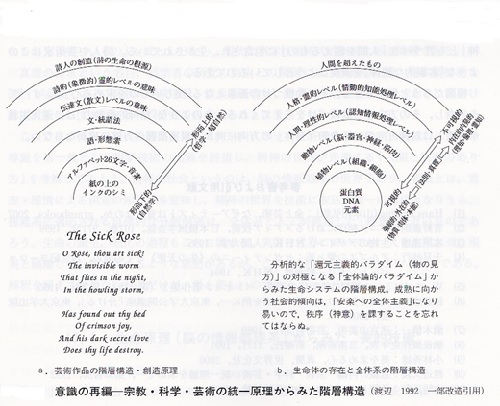
Figure 5.1 Reorganization of consciousness: Hierarchical structure seen from the unifying principle of religion, science, and art
(Watanabe 1992, partially modified)
From "Research into the Expression of Human Inner Sensibility"