The Road to Peace - Global Environmental Systems Design Theory (Building an Autonomous Decentralized Control Society)
Chairman of the World NGO Peace Ambassadors Council
and Chairman of the Japan-Korea Tunnel Promotion Nagasaki Council
-The sense of synchronicity among women's groups-
The construction of a Japan-Korea tunnel is a key element in designing an energy-centered global environmental system. Since this is a century-long project, it's best to hire someone with "purity" and "the ability to persevere." Whatever you do, you need to have a childlike "purity" first. It's young people who are satisfied with these projects. We need to build a foundation like the era of "100 million middle-class people," when group synchronicity and empathy are most likely to work. Today's young people have the volunteer spirit to rival or even surpass that of young people abroad, so the first step is to gain their inspiration and empathy. Furthermore, I believe it's essential for women to fully utilize their "persistence," "love of beauty," "non-war," as well as their "keen senses" and "delicate sensibility."
I believe that women become stronger in times of crisis. At the request of a women's group in Nagasaki, I served as the executive committee chairperson of a group to build a school in Guinea-Bissau (a small country with a population of about 1.2 million, at the westernmost tip of Africa) for 15 years, and have been working with them. The school's construction philosophy is based on the idea of "building an autonomous, decentralized, controlled society," with absolutely no financial support provided, and is carried out as an educational, cultural, and educational activity.
Amazingly, an elementary school was completed in just six years, and a junior high school in the eleventh year, and they are still improving their curriculum. It is a small school costing 3.5 million yen, but it has improved the situation where classes could not be held due to heavy rain, and the children are very happy. After all, in a country where the cost of living is $1 a day, a school can be built with just 3.5 million yen. I hear that they have already produced several graduates, some of whom have gone on to university.
Rather than collecting donations from the OECD or the prefecture and sending the money through public institutions, the women themselves went to the site to look for land, selected it, negotiated, and even selected carpenters and plasterers to build it. The funds came from the profits and tips from the sale of 1,000 yen tickets to charity concerts, film screenings, lectures, etc. by members of the Women's Federation for World Peace and other volunteers. It was Ms. Baba Kikuyo who actually built the school on site in this way.
My role in this support work is to propose a "methodology" for creating something new, and in response to the "please tell us something" that is always requested at the beginning of meetings, I talk about economic and technical issues in comparison with the current state of affairs. Specifically, I break down the vague, overarching proposition of "building a school in a small African country" into medium- and small-scale sections and individual tasks (in rugby terms, this is called handling the ball in a scrum). Once that's done, all that's left is to assign individual roles and plan and execute them accordingly. Along the way, I set up checkpoints (review committees) to check progress. This is compiled on an A4 sheet (for example, Figure 8.1) to create a comprehensive implementation plan diagram.
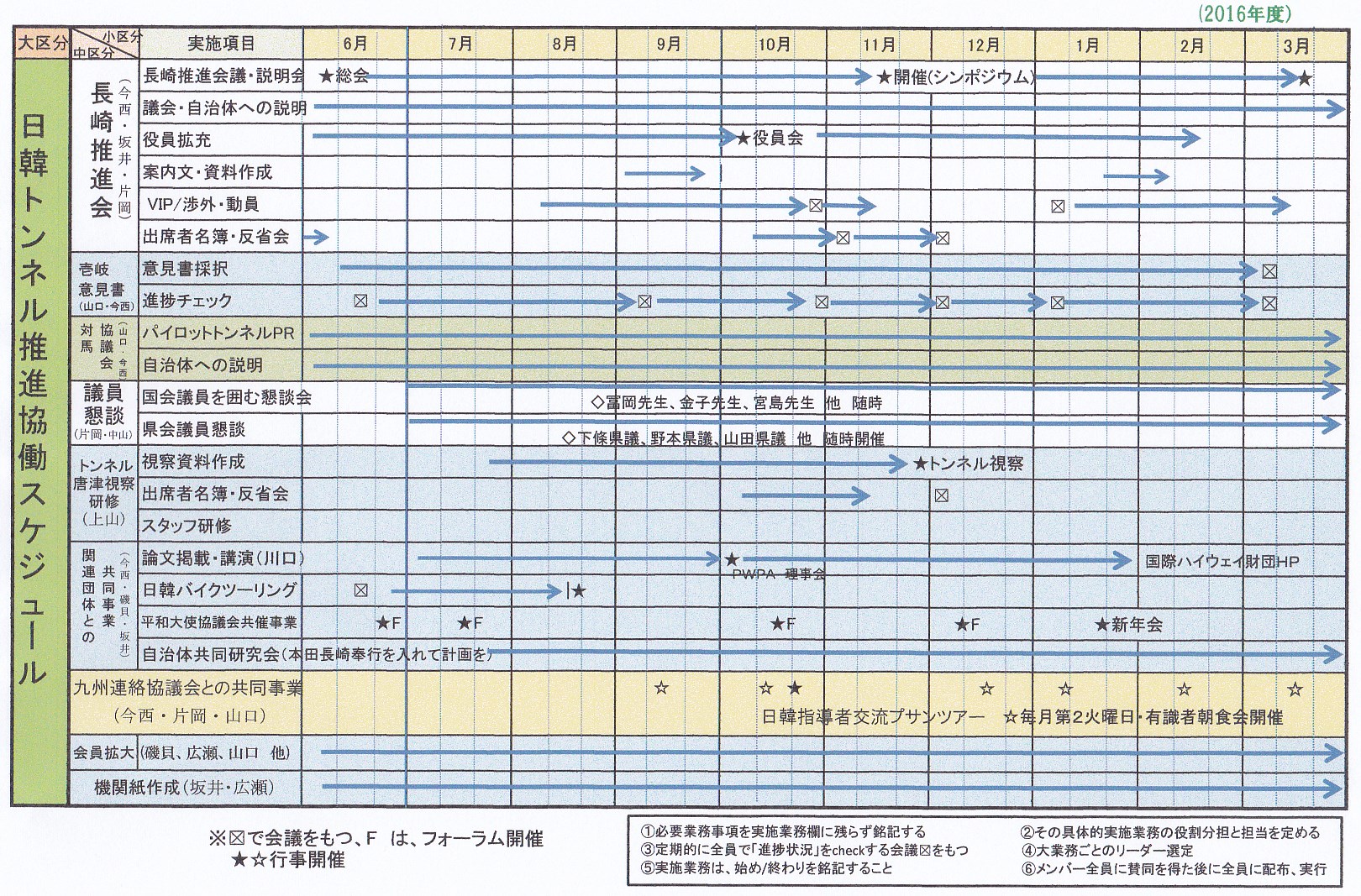
Figure 8.1 Comprehensive Implementation Plan for the Japan-Korea Tunnel Nagasaki Council in 2016 (Kawaguchi 2016)
In other words, it is a process management diagram used in new development projects in companies. When I first taught this to them, by the second year they were already finding their own themes and asking, "Is this good enough?" This would put even the most skilled corporate workers to shame. Then, after 15 years of discussing a theme, a "foundation for thinking" is formed, and the ability and imagination to take on any challenge is cultivated. Women have this kind of "persistence and mental fortitude." When this is achieved in a group, it develops into "collective intelligence" and then "group synchronicity." Women's "delicate sensibilities" firmly grasp this.
Let us consider the source of this "emergence."
Collective synchronicity, or how to move in a crowd, was in a sense a philosophical question for Doris Dorrie, as she says that the crowds she sees on the streets of Tokyo look completely different.
He began by saying that perhaps the motivation to make people feel this way is something like this, when he instructed several dozen Germans to "move freely like a school of fish" in a theatrical performance called "A School of Black Fish," but it didn't work out at all. It's not hard to imagine who would be directing the overall movement, unable to grasp the balance between individual individuals and the collective action of the group. However, Germany is a nation that demonstrated the self-organization and emergent synchronicity of large groups in the unification of East and West Germany (the fall of the Berlin Wall), and there is a very clear "group synchronicity." Perhaps, at the outset, some kind of motivational "fluctuation" or "inspiration" of "sensibility" is needed...
However, she says that people walking the streets of Tokyo naturally form harmonious groups . She points out that this synchronicity is similar to the "flow of groups at Shibuya's multi-level intersection" that often appears in the Tokyo TV video "Why Did You Come to Japan?", and that it is similar to what foreigners say when they say, "I came here to be immersed in it."
This realization and discovery offers extremely impulsive insights into human sensibility and its expression. Apparently, at first, she lacked the courage to join in the quiet, flowing movement. To avoid bumping into others, she had to be aware of the group's presence, even if only subconsciously. But once she was immersed in the group, she felt as if "she were wearing a cloak, immersed in a sense of security that allowed her to erase her own form ." What an expression of "delicate sensitivity." It's easy to understand why Emmanuel Todd said that "Japan and Germany are the only two countries where a sense of community" still remains.
German women's "keen senses" continue to this day.
Doris Derrier apparently went to the hot spring resort of Yamagiwa in Tohoku, stayed overnight, and went to the public bath. Because she was a mother at the time, she had the opportunity to get to know many Japanese women. She was able to join a "group, a group" of women.
What "moved me so deeply" about his experience in Japan was the scrupulous attention to detail and politeness that permeated every action the people took. "Consideration" was evident even in the smallest of tasks, and one could sense an attitude of treating everyone with the utmost care.
"I became convinced that the Japanese are masters when it comes to treating even the smallest things with a divine caress," he said. At the same time, "I began to think that this was an expression of the concept of mono no aware that I had heard about for a long time. It is finding love and joy in fleeting, ephemeral things."
In response to a journalist's question, "Do you think Germans can understand mono no aware?", he replied, "What the German and Japanese cultures have in common is 'order thinking,' 'romanticism,' and 'irrationalism.' In my interpretation, mono no aware arises when these three elements collide. Their sensitivity is not as developed as that of the Japanese, but I believe that Germans can also accept it."
As someone who feels that different information collides and gives rise to other, collective, synchronized information (inventions and discoveries), I believe that the woman's "embodied wisdom" is sharp, as it made me realize that this is also shared in the world of emotions. I am convinced that the ability to find connections between seemingly unrelated phenomena, or "sensitivity," will lead to success in whatever we undertake.
To what extent are the differences in behavior between men and women innate? The results of various experiments have not shown much difference in the relationship between brain function and behavior. The differences seem to be determined by "how to adapt to the environment" and where and how one grew up. There is no evidence that there are differences between mathematical brains and specialized brains. They are determined by acquired factors.
The performers speak words and the participants are asked to guess the emotions they are expressing. It is said that women are better at reading emotions, while men are better at spatial recognition, such as with maps. Boys prefer things with wheels, while girls naturally choose rabbits and dolls.
Interestingly, monkeys were given a number of toys to choose from. When tested to see how long they would play with them, females chose the dolls. They were not interested in trucks. Males were interested in trucks. They did not touch the dolls. This is similar to humans, but the reason for this is that females nurture their young in the womb for nearly a year and spend a long time raising their children, so this is likely a genetic predisposition. Male brains love to take things apart and destroy them, and are good at systematizing things, and these are said to be influenced by the hormone estrogen. Furthermore, although this may be a stereotype, men have the ability to concentrate and make decisions. However, women to do many different things simultaneously . In the brains of men and women up to around the age of 22, women have more circuits connecting the left and right hemispheres. Male brains appear to have a more developed network that links what they see to their actions.
These facts suggest that the difference between men and women is not one of behavior, but of emotion and feeling. In short, "sensibility" to create something soft, something physical, or something spiritual . This is confirmed by The Tale of Genji and The Pillow Scroll. Figure 8.2 illustrates the creative abilities of humans, regardless of gender. To increase brain activity and improve learning outcomes, it is essential for the emotional system (amygdala) to quickly determine that input information is "valuable ." In response to this emotion, the logical information processing system primarily considers the means and motivation, makes a comprehensive judgment, and then takes action. In other words, they autonomously discover their goals and take action . This process is repeated until an "optimal design" is achieved.
In conclusion, it can be said that what makes a "100-year plan" successful is the ability of "young people" and "women" that men lack. This is women's ability to "not wage war." In other words, it is because of women's unique character, that is, their sensitivity and skills, which allow them to continue living even in the face of the threat of annihilation.

Figure 8.2 Characteristics of information processing in the brain: Learning control by emotional (feeling) information (Kawaguchi 2010)
From "Research into the Expression of Human Inner Sensibility"