Chairman of the World NGO Peace Ambassadors Council
Katsuyuki Kawaguchi, Chairman of the Nagasaki Council for the Promotion of the Japan-Korea Tunnel
According to this "Global Environmental Systems Design Theory," Japan can efficiently reform its energy production structure. Like China, Japan relies on the Middle East Gulf region for 80% of its crude oil. Instead of building ships and hiring people to transport heavy oil from the Middle East nearly halfway around the globe, Japan could generate electricity using distributed energy sources such as wind power in the desert, large rivers, and biomass, and then store the electricity using hydroelectric pumped storage hydroelectric power generation and transmit it with the flip of a switch.
For private power generation, a high-calorie gas turbine that produces high-calorie gases (H2 and CO) from biomass and provides cogeneration would be ideal. Gas turbines do not require water and allow for highly efficient heat utilization. Of course, transmission losses are inevitable, so high-voltage transmission is required. However, the world's highest-voltage silicon carbide (SiC) semiconductor (capable of withstanding 21,700 V) has been developed, reducing transmission and transformation losses by about one-tenth (Kawaguchi Katsuyuki, "Nuclear Safety Myth" and "The Tower of Babel's Biodiversity Myth," World Peace Research, No. 199 (2013)). Mitsubishi Heavy Industries has successfully converted 10 kW of electricity into microwaves, transmitted them, and then converted them back into electricity, but this has not yet been put to practical use. The overall energy production, management, and distribution of this energy is the energy management system.
If the government is serious about achieving the impossible goal of economic growth, it must not simply collect money through finance, but must transform Japan's oil, coal, and nuclear-power-centered industrial structure, develop a heartland economic frontier, and usher in a mature society through electricity and energy transport via pipelines. The "pipeline corridor" is a northern energy corridor that will transport gas or crude oil to Hokkaido via Sakhalin through the development of Siberia.
In the South, the Japan-Korea Tunnel will be the centerpiece of the connection between Kyushu and the Heartland, the final frontier of the region, and will involve the production of distributed energy and optimal control (energy management system) to increase its utilization rate. In other words, the Earth will be constructing a single "global environmental system design." This is because there are still far more untapped energy sources (including distributed energy) lying dormant in this Heartland (the world island) than we could have ever imagined. Putin of Russia is calling for investment and collaboration in Russia to develop this potential.
Russian President Putin reiterated his strategic emphasis on the Asia-Pacific region in a speech to major global media outlets at the Asia-Pacific Economic Cooperation (APEC) summit on November 18, 2015. He argued that cooperation between the Russian-led economic bloc "Eurasian Economic Union" (comprising the five former Soviet republics) and China's national strategy "One Belt, One Road (the Silk Road economy on land and sea)" initiative, which also includes India, is the path to contributing to economic integration and peace in the Asia-Pacific region.
Putin has his sights set on the underdeveloped Siberian region of Russia's Far East. He has argued that the development of ports in the Far East and railway networks in Siberia, combined with the Belt and Road Initiative, will create an infrastructure link connecting the Asia-Pacific region and Europe, and has called for investment and technological collaboration with Japan and other countries.
Meanwhile, Germany, a land-based nation, is approaching China with the aim of becoming part of the heartland economic zone of Eurasia, and an alliance of land kingdoms is forming. European countries have shown their support for this initiative, which is why they were among the first to announce their intention to join China's Asian Infrastructure Investment Bank (AIIB), which will raise the funds for the bank.
Saudi Arabia is China's largest oil importer. King Salman issued a joint statement to upgrade bilateral relations to a "comprehensive strategic partnership" in line with China's "One Belt, One Road" initiative, a modern-day Silk Road economic zone initiative.
Perhaps it is the fate of a peninsula nation to rely on China for its economy and the United States for its security. North Korea's repeated missile launches and threats of nuclear tests sparked debate over the deployment of the THAAD system, and the United States and South Korea decided to deploy a new missile defense system this July. This has brought about a new crisis. China and Russia are strongly opposed to this. However, a Silk Road economic zone centered on the Japan-Korea tunnel would undoubtedly contribute greatly to the unification of the North and South Korean peninsulas and the "peace" of the East Asian economic zone.
Many would argue that the Trans-Pacific Partnership (TPP), or the Trans-Pacific Free Trade Area, should be a countermeasure. However, many politicians in the United States advocate "economic isolationism," arguing for the creation of trade barriers. Public skepticism toward free trade is on the rise, and trade agreements would expose certain industries to fierce competition and force them to shrink, making them ineffective in stimulating economic growth. This is fundamentally different from the "Heartland Initiative," which seeks to create an "economic frontier." Therefore, the Trans-Pacific Partnership (a maritime nation) will likely cooperate with the Heartland Initiative (a land-based nation). This is the only way forward if economic growth is desired, even for the sake of world peace. The Japan-Korea Tunnel will serve as a bridge between the two.
The TPP is an effort to impose common rules on member countries and stimulate trade and business activity. The Belt and Road Initiative has no concept of common rules or member countries. It is a flexible policy of "accepting whatever comes along." In short, China is looking westward to increase its influence in the international community while avoiding a decisive conflict with the United States.
We should create a $40 billion (approximately 4.8 trillion yen) "Silk Road Fund" and move forward with plans to cooperate with the Asian Infrastructure Investment Bank (AIIB), which will be established under China's leadership. This would be the most natural course of action, both for the sake of world peace and to pave the way for the development of linear motors (magnetically levitated super-high-speed trains).
On the other hand, the Japanese government's response, not just in education, has hardly reflected evidence based on overseas data in its decision-making process, and yet it has not done anything to verify the results or effectiveness using data from its own country.
In Japan, "expert councils" have been established where researchers and engineers give general opinions, but there is no sign of any strategic move to raise the level of research and development in the social sciences by having the government and researchers work together to conduct policy research, base policies on scientific evidence (intelligent design (optimal design)) ("How to Look at Things" I, II, III; Katsuyuki Kawaguchi, "World Peace Studies," World Peace Professors Academy). Expert councils of scholars and others seem to create an opportunity for "excuses" when things go wrong.
Japanese government often adopts its own methods without utilizing the knowledge of researchers and researchers. This leads to a repetition of Murphy's Law, which states that "anything that can go wrong will go wrong." This point needs to be improved urgently.
Recent research has pointed out that disparities based on family economic status already exist in the early grades of elementary school. Numerous studies have shown that investing in poor children reduces social costs. The government's most important job is to provide the necessary and sufficient support to the one in five poor children and eliminate disparities. Without this, the nation's "100-year plan," or "God's creation," cannot be realized. I believe that "God's creation" and "human creation" have the same origin.
Let's create a country where children can play freely in fields, mountains, parks, schools, and kindergartens. This will be the foundation for a healthy country where the birth rate reaches 2.0 or higher, on par with France, and where we can achieve a "100 million middle-class" population. Average Japanese people are intelligent. It is essential to "create the middle" in the population distribution.
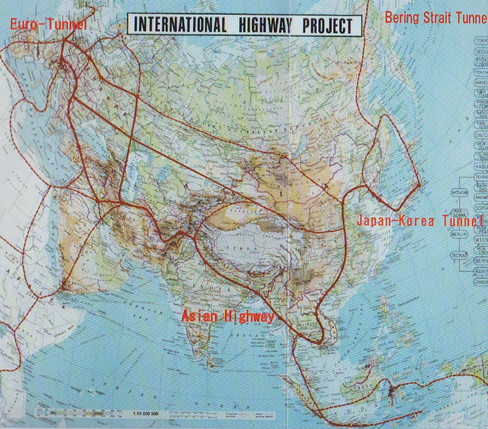
Figure 4.1 Linking the East and West of the Eurasian continent (land countries) with the Pacific Rim economic zone (maritime countries)
Japan-Korea Tunnel Corridor and Regional Pipeline Corridor (partially modified and excerpted) (International Highway Foundation 1982)