22nd Peace Road Forum Special Lecture
Hiroshi Mizohata, former Commissioner of the Japan Tourism Agency, makes a strong statement
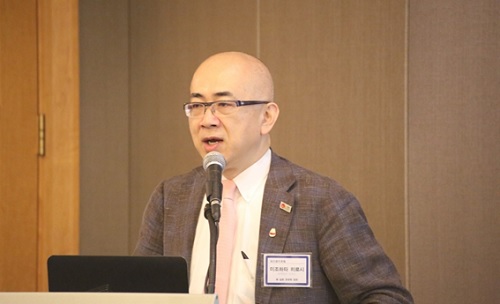
Thank you for taking time out of your busy schedules to come here today. Today marks my 89th visit to Korea. My most trusted and respected friend, Hwang-bo Kang (Director of the Technical Education Division of the Korea Football Association), is also here with us. Hwang-bo Kang and I met in Seoul in 1995, and we collaborated on the 2002 Korea-Japan World Cup and the founding of Ritsumeikan Asia Pacific University.
We also worked together until we hosted a soccer tournament in Oita Prefecture, Japan, and won, building a brotherly relationship between Korea and Japan. I have always felt grateful and respectful towards the Korean people, as I have worked with them on many projects and received their support. I like the national anthem, so I would like to sing it first before I begin my speech. (Although it was a little awkward, I sang the first verse of the anthem to the end.)
I was born in Kyoto. After graduating from the University of Tokyo, I joined the Ministry of Internal Affairs and Communications and began my career as a civil servant, hoping to contribute to Japan's development. While at the ministry, I introduced indirect taxes and achieved good results. I also spent a short time in Europe. My new goal in life is now to ensure that the three Northeast Asian countries of Korea, China, and Japan can achieve mutual peace and prosperity through close exchanges.
I would like to talk about the importance of the Japan-Korea Tunnel. When I was appointed to Hokkaido, the Seikan Tunnel between Hokkaido and Aomori opened. The two municipalities were in a position to decide where to draw the border between the two regions, and there was a great deal of sensitivity between them about how taxes should be levied. Because the length of the border was related to taxes, there was a clash of opinions. A heated debate ensued for four months, but after that, a mutual respect emerged. Extensive discussions were held about exchange plans between Hokkaido and Aomori, and the Shinkansen bullet train connecting the two regions opened, making the Seikan Tunnel a major artery for both regions. At the time, I realized how much the opening of the undersea tunnel would contribute to regional exchange.
After that, when I visited Oita Prefecture, a plan to connect Oita and Ehime prefectures came up, and I was also in charge of this. The project was to connect Kyushu and Shikoku with a bridge, but sports, culture, and economic exchanges followed. What I felt most strongly at the time was that Kyushu and Korea had to be connected. This feeling became even stronger when I went to Oita.
As the head of Oita Prefecture, I had to come up with a plan for utilizing the 2002 Japan-Korea World Cup, which was co-hosted by Japan and Korea. At the time, Korea and Japan were in a competitive relationship. I thought about founding a professional soccer team in Oita Prefecture, building a soccer stadium, and attracting 30,000 tourists from Korea, which I thought would revitalize the economy. If the Japan-Korea Tunnel were opened, it would stimulate exchanges between the two countries and make it easier to attract Korean tourists.
Before I discuss the Japan-Korea Tunnel further, I'd like to say a few words about my Korean friend, Hwangbo Kang. Prior to the Japan-Korea World Cup, he renovated a baseball field and built a soccer stadium from scratch, meeting and negotiating with many different people. Meeting with stakeholders from early in the morning until late at night was my daily routine. People need to dream big.
And you must never give up on that dream. In particular, leaders must work a hundred times harder than others to make their dreams come true. I worked with the belief that I could reach the top of Japan as much as I wanted. During that time, I met with Moon Jeong-sik, vice president of the Korea Football Association, and he gave me a lot of support.
I've loved soccer since I was a child. When I was in Europe, I supported European soccer teams and often went to watch soccer games. I still vividly remember a Japan-Korea soccer match at the National Stadium in 1976, where Japan lost 3-0. Korean players were quite tall, so I thought there was no way Japan could beat Korea in terms of skill. Korean soccer made a lasting impression on me at the time.
That's why, when it came time to form a soccer team in Oita Prefecture, I visited Korea, which is closer to Japan than teams from Brazil or the Netherlands, and asked for their cooperation. At the time, the World Cup was looming and a sense of rivalry was running high between Korea and Japan. I believe that even if Japan loses in the World Cup, there may come a day when we can cooperate with each other, so we shouldn't be obsessed with feelings between Korea and Japan. That's why I decided to found a soccer team with the cooperation of the Korea Football Association.
Vice Chairman Moon Jong-sik has been very helpful to me. When I was in Italy, where his parents live, I turned on the TV and saw Spain playing Korea. At that time, there was a Korean player who was performing brilliantly on the field and scoring a wonderful goal. That person is Hwang-Bo Kang, who is right here with us.
In the 1990s, Japan was always eliminated in the World Cup qualifiers, but Korea always made it through. Players like Hwang-Bo Kang brought out the best in Korean soccer. Even in 1995, Japan was still weak. I asked Vice President Moon Jeong-sik if I could bring in Hwang-Bo Kang, and he said he would be happy to introduce me.
Finally, on December 23, 1995, I met Korean superstar Hwang-Bo Kang at a hotel in Seoul. I boldly proposed to Hwang-Bo Kang that we create a team to represent Asia. To be frank, the team we were creating was in dire straits, with little financial resources and no soccer stadium. Hwang-Bo Kang was happy to come to Oita without any personal conflicts of interest. The following year, we created an Oita soccer team, and we hit it off, working together to lead it to a successful World Cup in 2002.
Ritsumeikan Asia Pacific University is Japan's first international university, and was established with the cooperation of Jeong Mong-jun, Honorary President of Ulsan University. In the process of establishing Oita Trinita, we received cooperation from many people in the Korean government, politics, and business world, and friendships were also forged. Since then, sports exchanges between Korea and Japan have progressed significantly.
It was a good experience for me. At that time, I visited Korea often in connection with the Japan-Korea World Cup. I learned that Korea has a great culture throughout the country and that there is much that Japan can learn from it, and I have learned a lot since then. I was also very impressed by Korea's excellent food culture, which is nutritious, balanced, and fermented. Above all, I was impressed by the kindness of Korean people and their respect for the elderly. During difficult and trying times, I received cooperation and support from many Korean people, including Hwangbo Kang. I may look cheerful, but I also went through difficult times, losing my hair and going through a divorce. At those times, it was Hwangbo Kang and many Korean people who helped and supported me.
During the 2002 World Cup, we wanted to promote Japan to the world. Finally, the World Cup was a success, which became a bridgehead for Korean and Japanese football, and now, 14 years later, Korean and Japanese football have reached the pinnacle of Asia.
When I founded Oita Trinita, I made a promise to the Korean Football Association. If we won in Japan, I would visit Korea with the trophy. That dream came true in 2008, and I did, as promised, visit Korea with the trophy. Unfortunately, the following year, in 2009, our team finished last, and I felt like I had fallen from heaven to hell. I was mentally and physically exhausted, and I received criticism from many people. After that, I resigned as team leader and was appointed to return to government service, becoming Commissioner-General of the Japan Tourism Agency in 2010. Having lived in Oita Prefecture for a long time and been involved in many World Cup-related projects, I took on the role with a desire to once again promote Japan to the world.
I think there are five things Japan is proud of. One of them is its beautiful nature. 70% of Japan's land area is covered by forests, making it comfortable and clean. This is also related to health and longevity. Japan has the longest life expectancy in the world. Japan has long had the technology to make things well. I believe Japan has the technological capabilities to dominate the world. If we discover and refine this technology and expand into the world, we can stimulate the development of each region and invigorate Japan as a whole.
I have long advocated that Japan, China, and South Korea should increase their mutual exchange population. According to Japanese data from 2014, the number of people exchanging information among the three countries is steadily increasing. A meeting between the heads of the Japan Tourism Agency was also held in Pyeongchang, Gangwon Province. During the meeting, bibimbap was prepared for 300 visitors in Pyeongchang and enjoyed together.
I am especially grateful to the Korean people. When the Great East Japan Earthquake struck, the victims were extremely exhausted, but they rushed to the scene faster than anyone else and provided a great deal of assistance. The tourism industry helped by sending tourists to Japan. I am still grateful to them. The Japanese people received the most support during the Great East Japan Earthquake, and I believe they should never forget that kindness and continue to repay it.
I believe that the Chinese economy will continue to grow in the future, contributing to the economic revitalization of Korea, China, and Japan. If the Japan-Korea Tunnel is fully implemented, exchanges among Korea, China, and Japan will accelerate. The 2018 Winter Olympics in Pyeongchang will ultimately serve as a catalyst for promoting tourism and culture among Korea, China, and Japan. This has led to the 2019 Rugby World Cup in Japan and the 2020 Tokyo Olympics. I believe that these major global events will be an opportunity to greatly expand exchanges among Korea, China, and Japan. If we miss this opportunity, future exchanges among Korea, China, and Japan will likely become more difficult. How we spend this period is a major issue.
Asia's population has surpassed 4 billion and is expected to reach 5.5 billion by 2030. With Korea, China, and Japan at the center, we must explore how we can drive the economic development of developing countries such as Vietnam, Myanmar, Cambodia, and Malaysia and revitalize the economy of Asia as a whole. This is a crucial issue not only for the region but also for the development of the global economy.
Japan has now formulated 10 plans for economic growth over the next 10 years, including the Fourth Industrial Revolution, renewable energy, and housing remodeling. Through these plans, the country aims to increase overall productivity and connect with the world. I believe the Japan-Korea Tunnel Project will play a very important role in expanding new distribution and export tourism sectors with Asian countries.
When I was Commissioner of the Japan Tourism Agency, many people expressed their opinions regarding the Japan-Korea Tunnel. The business community also recognized its necessity. Many people had positive views regarding the Japan-Korea Tunnel. One of the opinions was that the Japan-Korea Tunnel would promote and expand exchange relations between Korea, China, and Japan. Both Korea and Japan have seen their growth rates continue to decline, and they need dynamism to revive their economies.
Mediocre efforts will not suffice. Everyone must think to the fullest and pool their efforts. We must bring about a change in thinking, one that connects Eurasia into a single market. In terms of Asian dynamism, if the Japan-Korea Tunnel proves even more significant for the global economy than the joint hosting of the Japan-Korea World Cup, the long-term effects of economic exchange will surpass those of the World Cup.
Japan's population is also declining rapidly. The current framework for economic growth has its limits. We should take an active interest in the Japan-Korea Tunnel as a way to create a new, major economic trend. The Japan-Korea Tunnel would have enormous ripple effects in all directions, including the development of politics, economy, sports, and culture in both countries, as well as tourism, distribution, technological development, human resource development, regional revitalization, and peace in Northeast Asia.
It's been a year since I first became involved with the Japan-Korea Tunnel project. In Japan, private councils called Japan-Korea Tunnel Promotion Councils have been formed in 34 of the 47 prefectures, with members of the Diet and local government leaders participating. I believe that the Japan-Korea Tunnel issue will become even more active in the future, to the point where it will be seriously discussed in the Diet.
The ultimate goal is for the Japan-Korea tunnel to become a government project. If possible, I think that a round of meetings should be held at the ministerial level of the Korea-China-Japan relations conference to discuss the matter. Japan is steadily making preparations at this level. I think that Korea should also move forward with the tunnel plan at the government level. A new momentum needs to be created across the Republic of Korea.
Organizations to promote this project should be created not only in Busan, but also in towns, villages, and provinces across the country, as well as in Seoul. I believe the South Korean president should also consider this and work hard to make it a reality. During the Japan-Korea World Cup in the past, the leaders of Japan and South Korea met almost daily to discuss the matter. What's more important is that we must abandon the vague idea that the Japan-Korea tunnel will one day be realized. In my case, I only proceed with my work once I've decided by when it will be realized. If the completion date of a project is uncertain, no one can take responsibility for the outcome.
For example, we should draw up and confirm a plan to "pass an intergovernmental agreement on the Japan-Korea Tunnel by 2020 and ensure construction begins by 2030." In the future, Asia will host global events, such as the 2018 PyeongChang Winter Olympics, the 2020 Tokyo Olympics, and the 2022 Beijing Winter Olympics. We need to have top-level discussions, including with ministers from both Japan and Korea, to advance the Japan-Korea Tunnel construction plan as a success story for hosting these major sporting events, and create a plan.
A revolution starts with one person. I believe that if we have the determination to do this and see it through to the end, even if no one else understands, we must be prepared. I believe that this project will be a success if each and every person who understands the value of the Japan-Korea Tunnel cooperates with the determination to work together for the future of Korea and Japan.
I hear that South Korea is currently facing economic difficulties with the arrival of a new president. Japan's economies are also growing in its major cities, but regional cities are facing difficulties. Both Japan and South Korea face common challenges due to the disparity between major cities and regional cities. To overcome these challenges, we should set a goal of starting construction on the Japan-Korea Tunnel by 2030 and move forward with the "World Cup spirit." I believe it's important for both Japan and South Korea to create positive momentum for the future.
I believe the time has come for Korea and Japan to do business together. The Japan-Korea Tunnel could be the biggest business venture for both countries. I have been so well-received by many people in Korea, so I would like to take the lead in promoting exchanges and economic revitalization between Japan and Korea as a way of repaying that kindness. I hope that today's meeting will once again lead to the opening of the Japan-Korea Tunnel. I will also do my best to contribute, however small my contribution may be, from Japan.
(This article is an excerpt from a speech given by Hiroshi Mizohata (57, Chairman of the Osaka Convention and Tourism Bureau, former Commissioner of the Japan Tourism Agency) on the topic of "The Japan-Korea Tunnel: The Dynamism of Economic Exchange in East Asia" at the 22nd Peace Road Forum held at the JS Marriott Hotel in Banpo-dong, Seoul on July 17th.)
Hiroshi Mizohata
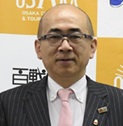
After graduating from the Faculty of Law at the University of Tokyo, he joined the Ministry of Home Affairs (now the Ministry of Internal Affairs and Communications), and served in Oita Prefecture as Director of the Finance Division, Director of the Cultural Promotion Division, and Deputy Director of the Planning Department (responsible for the World Cup and universities), before serving as Commissioner of the Japan Tourism Agency under the Ministry of Land, Infrastructure, Transport and Tourism.He currently serves as Chairman of the Osaka Convention & Tourism Bureau and as a director of Oita Football Club, where he is committed to developing Japan's tourism industry and promoting sports.
The original Korean text has been translated into Japanese.
The original text can be viewed at the link below or as a PDF.
South Korea should also establish a "Korea-Japan Tunnel Promotion Committee"

The Japanese translation PDF is available below.