■ 40 experts from Geoje Island, Korea, inspect the Karatsu Nagoya Incline Shaft
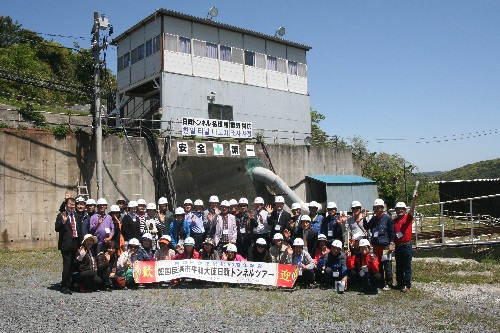
[Photo] 40 visitors from the Geoje City Peace Ambassadors Council in South Korea
Geoje Island is the planned landing site for the Korean side of the Japan-Korea Tunnel. Located in the South Sea of the Korean Peninsula, just west of Busan, it is the most likely location for the tunnel that began in Tsushima to emerge above ground and head north up the peninsula toward the Eurasian continent. On April 30th, a group of 40 experts and peace ambassadors from Geoje City visited the Nagoya Incline Shaft in Karatsu to inspect it.
After a 20-minute briefing by Director Okubo to confirm the progress and significance of the tunnel plan, the usual procedure is to inspect the end of the 540m inclined shaft. However, this time, as the site was on the Korean side, the Q&A session and discussion became heated. "In terms of distance, Busan is the closest to Tsushima. However, the Korea Strait off the coast of Busan has deep waters and soft geology. Our engineers believe that the area off Geoje Island is more suitable for tunnel construction," Director Okubo said, drawing loud applause.
Even those who thought, "We can have exchanges as we are now without having to go to the trouble of digging a tunnel," commented, "From the perspective of world peace and the unification of North and South Korea, the Japan-Korea tunnel would play a major role. I now believe it is absolutely necessary."
One participant brought a photo of the groundbreaking ceremony on Geoje Island 30 years ago and spoke passionately, saying, "Japan is more advanced in the tunnel project, but we want to keep up with Korea's." The groundbreaking ceremony was held on Geoje Island in 1988, and four boring surveys were carried out. "Initially, 12 borings were planned, but in reality, only four were drilled. Unfortunately, we were unable to build an inclined shaft, but we have preserved the boreholes from that time," he said, showing his enthusiasm for future progress.
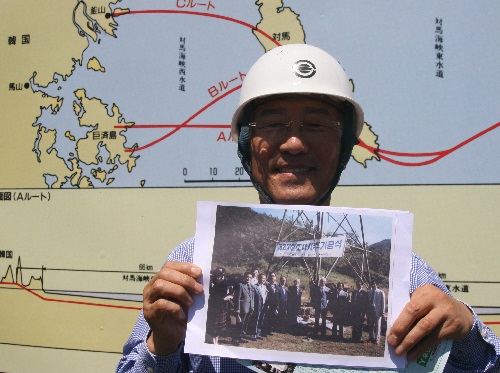 [Photo] Visitors holding a photo of the groundbreaking ceremony on Geoje Island in 1988.
The late Yasuo Sasa, founding chairman of the Japan-Korea Tunnel Research Association, can be seen in the center with a panel in the background.
This is a historical area where Hideyoshi Toyotomi's navy was defeated by the turtle ship of General Yi Sun-sin, who would become a hero in Korea, in the waters west of Geoje Island 400 years ago when he invaded Korea. With his supply lines cut off, Hideyoshi's army was forced to retreat. Jinhae, deep inside the island, was the site of a naval base led by General Yi Sun-sin, but it is now the site of a Korean naval base.
Furthermore, 110 years ago, during the Russo-Japanese War, the Japanese Navy, including the battleship Mikasa commanded by Vice Admiral Togo Heihachiro, conducted exercises off the coast of Geoje Island to welcome the Russian Baltic Fleet. The South Seas of Korea are known as the "archipelago," a sea dotted with numerous islands that sparkle like jewels, and Geoje Island is one of them. As with the "Blue Cave" in Yabakei, Nakatsu, Oita Prefecture, the Japan-Korea Tunnel also holds great significance as a symbol of the bond between Japan and Korea "beyond the bonds of gratitude and enmity" (by Kan Kikuchi).