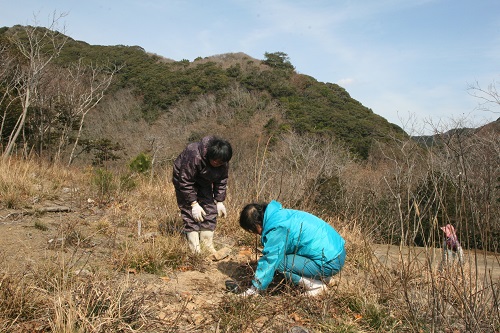
In Tsushima, prior to the start of construction on the Japan-Korea Tunnel's Aren Incline Shaft, work was underway to plant cherry trees on the site to create a "cherry blossom orchard." The "International Highway Project" aims not only to build a road, but also to actively contribute to the region's economic development and environmental improvement. The cherry trees were kindly provided by Yoshiharu Kanazawa, chairman of the Kanagawa Prefectural Council for the Promotion of the Japan-Korea Tunnel. They are "Somei Yoshino" saplings, with two-year-old spikes grafted onto five-year-old bases, making them easy to root. One hundred trees were planted on Tsushima, 67 on Iki, and 33 on Karatsu, with plans calling for the area to eventually become a 1,000-tree cherry blossom viewing spot.
On Tsushima, four local people, five construction company workers, and two workers from the foundation planted the trees over three days on March 5th, on Iki from the 8th to the 11th three workers from the foundation planted the trees, and on Karatsu on the 20th they planted the trees with local collaborators. Tsushima is a rocky island, so even digging a hole takes time, and the soil had to be softened to make it easier for the roots to grow, so excavators were used. There are also concerns that the trees will die from lack of water, and that deer and wild boars will eat the seedlings. In that case, the trees must be protected by fencing them off.
[100 trees were planted on Tsushima Island along the inclined shaft site and the work road leading to it]
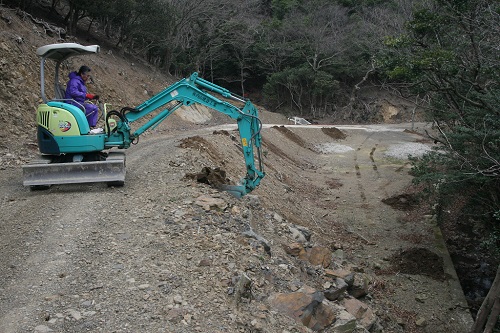
Mr. Kanazawa, who provided the cherry tree seedlings, has been instrumental in realizing the Tokyo Bay Crossing Highway and is also passionate about planting cherry trees. Last year, he visited the Karatsu and Tsushima sites and is currently working hard to realize the Japan-Korea Tunnel.
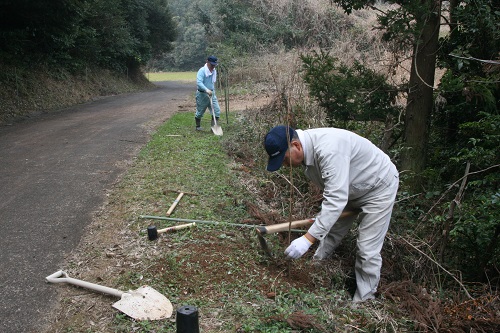
[67 trees planted in Iki]
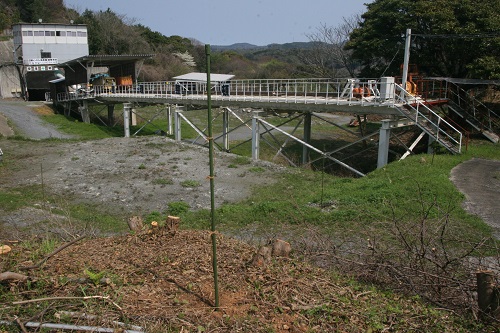
[33 trees planted on the Karatsu Nagoya Incline Shaft site]
International Highway Foundation Newsletter April 2014 (PDF view/download)