In recent years, the Japanese archipelago has been hit by heavy rains that continue for several days, causing frequent disasters across the country, including landslides and flooding of homes. Disasters caused by so-called "linear rain bands" have also been occurring on Tsushima since last year. At the Nichikan Tunnel site, the access road to the tunnel entrance was eroded by rain and sediment accumulated, causing roadway obstructions. In particular, Typhoon No. 5, which struck Tsushima on July 20th of this year, caused the greatest damage to the site to date, so much so that an evacuation advisory was issued for Izuhara, in the center of Tsushima.
Therefore, work is currently underway to repair the damaged road and concrete the access road. First, work will be carried out on the 500m section from the steeply sloping pass to the coastal entrance, and work has now progressed to the 100m section. This will allow inspection teams to be accommodated in large buses, as before.
Since July of this year, Korean tourists have stopped coming to Tsushima due to the conflict between the Japanese and Korean governments that began last year over the "forced labor" issue. Tourist buses remain parked in parking lots, guesthouses and hotels are deserted, and the town remains completely quiet. Even so, group tours of Japanese baby boomers, who have previously been busy traveling abroad, are still noticeable. If the benefits of the Border and Remote Islands Act are extended to Japanese tourists to Tsushima, its prosperity should continue.

[Photo] Concrete paving has progressed up to 100m from the coastal entrance as of August 31st
Meanwhile, inspection teams from Hokkaido visited the Japan-Korea Tunnel and Tsushima-Aren Inclined Shaft site on August 22nd, Ishikawa Prefecture on the 28th, and Aichi Prefecture on the 29th. This was the second time for the team to visit Hokkaido, following their visit last summer, and the Promotion Council officials commented that in addition to the magnitude of the international highway concept, "I visited for the first time last year and was deeply moved by the beauty of the natural scenery.
"We share the same border position, and our relationship with our neighboring country is crucial. I would like to go to Kamishima next year," he said. Ishikawa Prefecture also commented, "I have visited the Karatsu inclined shaft site many times, but this is my first time on Tsushima. Tsushima has had connections with the continent and the peninsula since ancient times."
Furthermore, five city council members from Aichi Prefecture visited the site and asked specific questions about the feasibility of the project. "Tsushima is a site surrounded by magnificent nature, so you really can't know until you come and see for yourself," they commented.
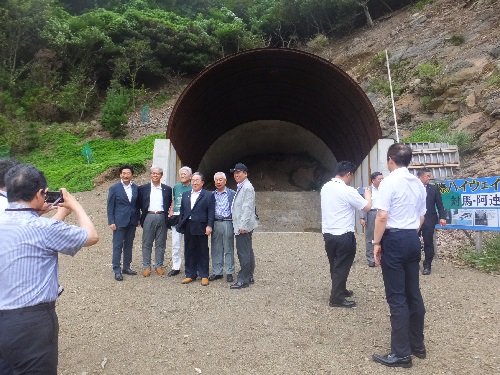
[Photo] Tsushima, Aren Inclined Shaft Entrance. Each person was checking the situation at the site.