■Tokyo publishing company Kogensha will film the event and create a promotional video
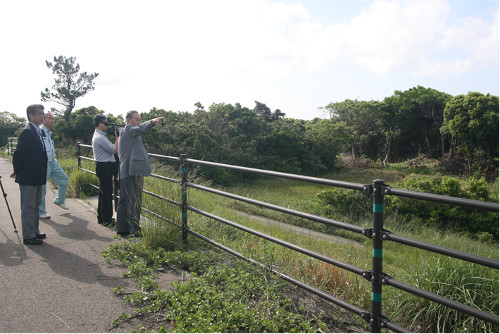
[Photo] The Kogensha photography team listens to the plans for the planned Iki Ashibe Inclined Shaft site
To film the "International Highway: Japan-Korea Tunnel," which proposes a concrete measure for world peace, Tokyo publishing company Kogensha filmed the tunnel inclined shaft sites in Karatsu, Iki, and Tsushima for about a week. The video will not only capture the progress of tunnel construction, but also historic sites, museums, and scenic spots, creating a film about the "Iki-Tsushima Route" connecting Japan and Korea.
Additionally, several videos will be completed by summer, including interviews with chairpersons and organizers of prefectural councils across the country who are politically working to promote the construction of a Japan-Korea tunnel. If we can concretely imagine an international highway or tunnel that connects countries across borders and allows people to travel freely, the project will likely move forward at an accelerated pace.
The three-man filming team from Kogensha filmed from May 11th to 16th in Karatsu, Iki, and Tsushima, in that order. Karatsu was hit by heavy rain due to an unseasonably approaching typhoon. After interviewing Director Okubo Yoshitaka about the progress of tunnel construction on site, the team filmed inside the inclined shaft and the site.
The young cameraman, who was visiting the site for the first time, stood at the end of the 540m tunnel at the Karatsu Nagoya Incline Shaft and said, "There are things you can only feel when you see it with your own eyes and walk through it with your own feet. You can't understand it just by looking at it from Tokyo," as he filmed with a deep emotion but a calm demeanor.
The next morning, we visited the ruins of Nagoya Castle, which was the base of operations for Hideyoshi's invasion of Korea, and looked out over the Genkai Sea and the islands from the remains of the castle tower. The filming team, who continued to turn their cameras around the islands even in the rain, showed their photographer's spirit, and it made me think about how Hideyoshi stayed here for a total of one year during this invasion, known as the "Seven Years' War," and how he might have felt a sense of peace when he saw the same scenery.
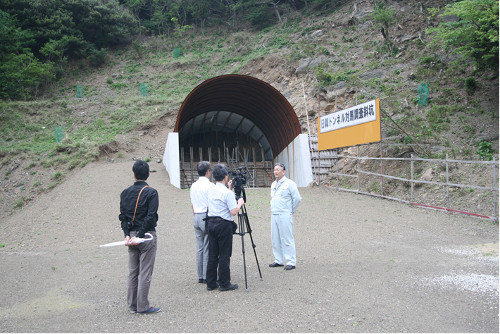
[Photo] Interview with Director Katsuyuki Uchiyama at the entrance to the inclined shaft
On the afternoon of the second day, we crossed over to Iki Island. We visited the planned site for the inclined shaft in Ashibe and interviewed Director Seihachi Matsumura. After viewing the site from the sea side of the nearby fishing port, we walked around the site, pushing our way through the grass, where precise surveying will soon be carried out to locate the shaft entrance.
A sandy beach with waves lapping against the backdrop of the blue Genkai Sea, where a regular ferry leaves a white wake, is an ordinary scene on the island of Iki, but here appears the Japan-Korea Tunnel, a combination of human wisdom and cutting-edge technology, a combination of "divine skill and human skill."
To get a sense of the distance between Karatsu and Tsushima, which are connected by a tunnel, we also looked from the observation deck at Takenotsuji, the highest peak on Iki, and Saruiwa on the west coast, but Tsushima was not easily visible due to clouds after the typhoon.We also visited the historic site of Harunotsuji Ruins and the Ikikoku Museum, where we photographed the prosperity of the Gishiwajinden era.
A veteran videographer from the filming team said, "The director of Iki has been working here without changing his focus for 30 years. He's a true professional," expressing interest in the lives that have been sacrificed behind the scenes of this major undertaking, and said it would be interesting to film the way people live their lives.
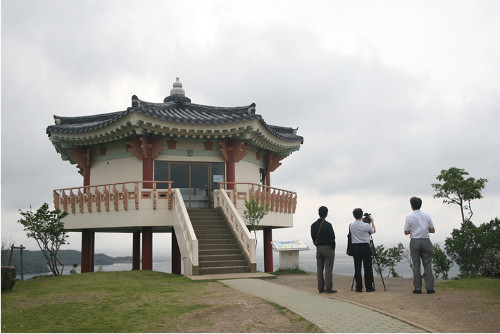
[Photo] Trying to capture Busan on video from the northernmost tip of Tsushima
We crossed over to Tsushima in the evening of the third day. Tsushima is a border town. This is the main location for our current filming, and is also an area the foundation is currently focusing on. We interviewed Director Uchiyama Katsuyuki at the entrance to the Aren inclined tunnel, which was completed last July. The director spoke of his dreams and hopes for the future, saying, "Next, we would like to extend the tunnel entrance by 10 meters and prepare to install a winch. We will also need to secure electricity and water." Also, at Aren Beach west of the tunnel entrance, the chairman spoke enthusiastically, saying, "This direction is Geoje Island in South Korea, and the tunnel will run 66 km in that direction."
The president of Kogensha expressed his hopes, saying, "We want to make videos from several different perspectives so that more people can learn about this project. Tsushima is an important place for Japan, but it is also a place of interest for Korea. I hope that Tsushima will become a place that serves as a pioneer for world peace."
The filming team visited Banshoin Temple, the museum, the grave of Amemori Hoshu, Watatsumi Shrine, Mt. Eboshi, Manseki Bridge, as well as the Korean Observatory in Kamitsushima and the Japan-Russia Friendship Hill, capturing the beauty and history of Tsushima on camera. Tsushima, with its scenic coastline due to the Earth's mountain-building activity and geographical environment, and its history of exchange with the peninsula since the Jomon period, can provide humanity with a "concrete image of world peace," and it will move on to a new stage.
Mountains, rocks, ocean, waves, coasts, sandy beaches, birds, flowers... The videographer points his camera at every corner of nature, capturing images with loving care. The staff member checks and records the footage as soon as they return to the accommodation. We look forward to the footage that will be produced.