◆Iki, where trees have been cut down and detailed surveying is awaiting Iki
was able to prepare the tunnel site early on, but as it was planned for the latter half of the construction schedule, we have been keeping a close eye on the progress in Karatsu and Tsushima. With the tunnel entrance installed in Tsushima last summer, it is finally Iki's turn. The trees on the site, which was somewhat barren, have been cut down, and detailed surveying is scheduled to take place this year in preparation for the installation of the tunnel entrance. For more details, please see last year's November and December of "Field Report.
The next photo shows the view from Takenotsuji (213m), the highest peak on Iki, located in the southern part of the island. The gourd-like island is Matsushima, and the main tunnel is planned to pass underneath it. The island to the left of it is Kakarajima, the island where King Muryeong was born.
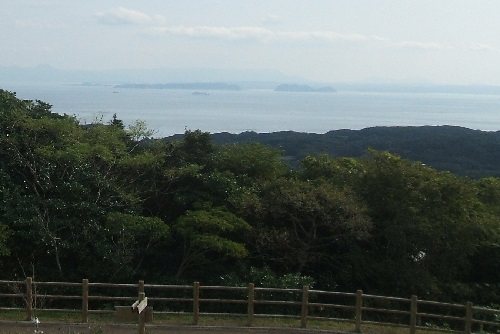
[Photo] Karatsu as seen from Takenotsuji, Iki. Beyond Matsushima and Kakarajima lined up in the center is the Karatsu Nagoya Inclined Shaft
The tunnel runs from the southeastern part of Iki along the east coast, then heads west from the northern part of the island, aiming for Tsushima, 50 kilometers away. Unfortunately, Iki Island is not large enough that the tunnel cannot emerge above ground. The Obon-shaped island with no high mountains is once blessed with farmland, and was once the number one rice producer in Nagasaki Prefecture. However, during the Kamakura period, when the Mongol army attacked, the islanders had nowhere to escape and were completely wiped out.
Turning north, you can see Tsushima, 50 kilometers away, as shown in the next photo. Compared to Iki Island, which is 17 kilometers north to south, Tsushima, which is 80 kilometers away, is faintly visible, stretching out like a ribbon on the horizon.
The sea stretching from Iki to Kyushu feels calm like an inland sea compared to the rough Tsushima Strait, and ancient people who crossed it in small boats would have felt relieved, thinking, "We're almost there!" Conversely, we can get a glimpse of how people waited for the wind and waves to calm down before crossing to Tsushima, praying for a safe voyage.
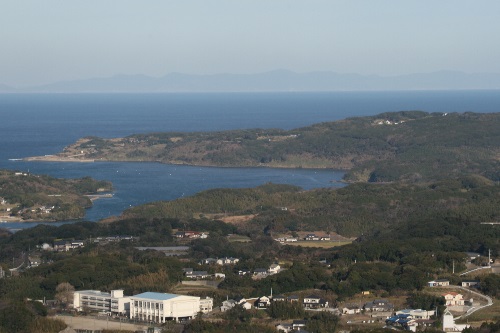
[Photo] Tsushima seen from Takenotsuji in Iki. The island's silhouette is visible as a thin band along the horizon.
Iki and Tsushima were the main routes connecting Japan to the peninsula and the continent. The third-century "Wei Zhi Wakokuden" contains a description of "Iki Province" (Iki Province). The Yayoi period moated ruins, "Haruno Tsuji Ruins" in the southeastern part of the island, have been designated a special national historic site, equivalent to a national treasure, and are known to have been the royal capital of Iki Province.
On a small hill overlooking the ruins stands the Ikkikoku Museum, a posthumous work by architect Kurokawa Kisho, which opened in March 2010. In December 2013, the remains of an above-ground furnace for iron production were excavated at the Karakami ruins, revealing that this was Japan's first smelting furnace, where swords, spades, and hoes were made, indicating that advanced technology was in place during the Yayoi period.
In the center of Iki Island, there is Tsukuyomi Shrine, said to be the oldest shrine in Japan, dedicated to Tsukuyomi-no-Mikoto, which is said to have split off into Matsuo Taisha Shrine in Kyoto, and shrines spread throughout the country. Tsukuyomi-no-Mikoto is likened to the moon as the god who governs the night, and Iki, along with Amaterasu Omikami and Susanoo-no-Mikoto, who govern the day, are important islands for understanding the Kojiki.
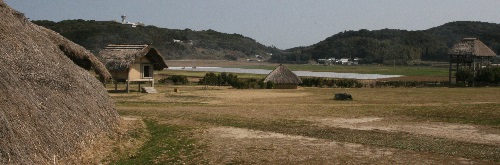
[Photo] The Yayoi moated ruins of Harunotsuji Ruins and the Ikikoku Museum (top left, rear) standing on a small hill