A meeting of Korean and Japanese experts was held at the Busan Chamber of Commerce and Industry to examine the technical issues surrounding the construction of the Korea-Japan Tunnel and to propose new optimal plans.
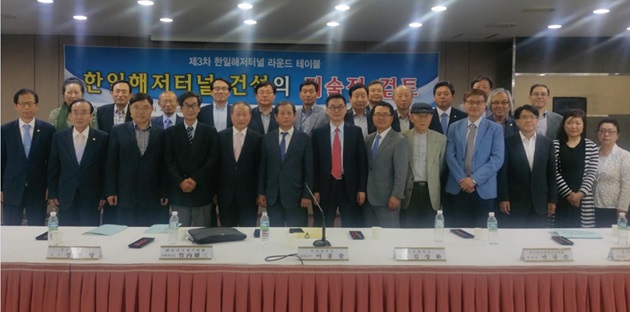
The Korea-Japan Tunnel Study Group, together with the Busan Chamber of Commerce and Industry, the Busan Global Forum, and the Busan Development Gathering, held the 3rd Korea-Japan Undersea Tunnel Roundtable on May 24th in the second floor conference room of the Busan Chamber of Commerce and Industry.
The purpose of this meeting was to examine examples of undersea tunnel construction in various countries and to review technical considerations for building an undersea tunnel between Korea and Japan.
The conference began with a presentation by Professor Lee Jeong-cheol, professor emeritus of civil engineering at Busan University of Economics, and Professor Kim Sang-hwan, professor of civil engineering at Hoseo University, on "Technical Considerations for a Korea-Japan Undersea Tunnel." The discussion that followed included Yuzo Takeuchi, chairman of the technical committee of the International Highway Foundation; Park Kwang-jun, vice president of the Korean Society for Tunnels and Underground Spaces; Lee Kyung-jun, managing director of Dong-A Geotechnical Technology; Professor Jeong Hon-young of Busan National University; and Choi Chi-kuk, former head of the research lab at the Busan Development Institute.
Professor Kim Sang-hwan introduced examples of undersea tunnels currently under construction or in operation around the world, and after examining previously proposed route options for undersea tunnels, proposed the optimal route. Professor Kim proposed four optimal route options: Route K1+J1, Route K1+J2, Route K2+J1, and Route K2+J2. The shortest of these is Route K2+J1, connecting Gangseo-gu, Tsushima, Iki, and Dangjin, with a total length of 278.4 km. He continued, "There are no technical issues with building a Korea-Japan tunnel, but further detailed research is needed."
During the discussion, Technical Committee Chairman Takeuchi said, "Based on our experience at the Seikan Tunnel construction site, which connects Japan's Honshu and Hokkaido, we expect the construction to be extremely difficult, as most of the work will be more than 200 meters below sea level. We need to develop equipment that can dig long distances of 5 to 10 kilometers." Lee Kyung-jun, executive director of Dong-A Geotechnical Technology, said, "Currently, there are almost no cross-sections of the seabed in Korea. We need to thoroughly survey the great depths of the seabed using robots and dig test tunnels several kilometers long in specific sea areas to investigate."
The event was attended by over 50 people from various fields, including Seo Ui-taek, Lee Young-hum, co-chairs of the Korea-Japan Tunnel Research Association, Han Seung-wan, chairman of Gyeongsang University, Lim Hyo-il, head of the UPF Geoje branch, Kim Young-gil, chairman of the Geoje National Union for the Unification Movement, and Son Dong-hoon, head of the Geoje Church of the Family Federation.
The original Korean text has been translated into Japanese.
The original text can be viewed at the link below or as a PDF.