An article introducing the World Summit 2020, held in Korea from February 3rd to 5th, was published in "Net IB News." Speakers at this huge international event included Jim Rogers (one of the world's three largest investors, who visited the International Highway Foundation's Karatsu site last year) and Yukitaka Ishii (former chairman of JR Kyushu, a proponent of the Japan-Korea tunnel and advocate of the name "Asia Strait Tunnel").
The following is the content of the article.
-----
The World Summit 2020 (sponsored by the United Nations University Press) was held from Monday, February 3rd to Wednesday, February 5th at the KINTEX international exhibition center in Goyang, Gyeonggi Province, South Korea.
Amid the coronavirus outbreak in Wuhan, China, approximately 6,000 people from 120 countries gathered, including around 150 current and former world leaders, members of parliament, religious leaders, media representatives, Nobel Prize winners, and former UN Secretary-General Ban Ki-moon from South Korea.
Prior to that, the 2020 World Peace Media Conference (co-hosted by South Korea's Saegye Ilbo, the US's Washington Times, and Japan's Sekai Nippo) was held at the Lotte Hotel in Myeongdong, Seoul on Sunday the 2nd, and attracted approximately 500 media professionals, scholars, business leaders, and others from 100 countries around the world.
Here we will mainly report on the World Congress of Public Opinions and the economic subcommittee, the International Association for Peace and Economic Development (IAED), which also included Jim Rogers and Neil Bush.

Neil Bush
From the following day, the 3rd to the 5th, a general meeting (theme: "Realizing World Peace and the Reunification of the Korean Peninsula through Coexistence, Co-prosperity, and Common Meanings") and various subcommittees were held at the KINTEX International Exhibition Center in Goyang, Gyeonggi Province. Subcommittees were held at various venues, including the International Summit Conference for Peace (ISCP), the International Association of Parliamentarians for Peace (IAPP), the Inter-Religious Council for Peace and Development (IAPD), and the International Association for Science and Technology for Peace (IAPP).
Here we bring you a report on the International Association for Peace and Economic Development (IAED), which was held from the afternoon of the 4th to the morning and afternoon of the 5th.
The International Association for Peace and Economic Development (IAED) is a forum for active discussion aimed at achieving sustainable peace, primarily among business people. In order to ensure the long-term prosperity of the world, we must continue to pursue peace within limited resources.
This time, big-name speakers included Jim Rogers, one of the world's three greatest investors, and Neil Bush, the younger brother of former President George W. Bush and a businessman with extensive experience in China and Asia, as well as Yukitaka Ishii, former president and chairman of JR Kyushu, speaking from Japan.
Jim Rogers spoke with a large slide of the world map as his backdrop:
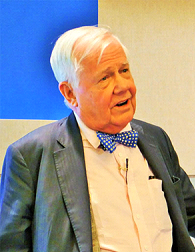
Jim Rogers
"I am very happy to have been given this wonderful opportunity, and above all to be here on the Korean Peninsula. The reason is that the Korean Peninsula will undoubtedly become the most exciting and fun region in the next 10 to 20 years. The 38th parallel is located not far from here. The time is approaching when we will witness the historic moment when it will disappear. I hope to talk about Asia with you all today.
About 13 years ago, I sold everything I had in New York and moved to Asia with my family (we now live in Singapore) and I want my children to grow up in Asia, speaking Mandarin (which will be one of the most important languages in their lives).
The 19th century was the British century, and the 20th century was the American century. The 21st century is the Asian century, centered on China. I'm sure there are many people in the West who are not happy with this trend. However, I think you will understand that China has been the most successful country over the past 40 years. China's drive to take on new challenges has led to its current development.
I believe that neighboring Asian countries will develop with the help of China in the future. The United States is a country with great economic power. However, the gap between rich and poor is widening, and it has the highest debt in history, and that debt continues to grow. History teaches us that no matter how dominant a country may be, it will experience repeated periods of rise and fall. Of course, I believe that Asia will face various difficult problems in the future. However, there is no wavering in the overall direction of Asian development. In Korea, I believe that the unification of North and South Korea will open up a new path. The reason is that it was originally one country.
In a subsequent Q&A session, Jim Rogers also mentioned the Asia Strait Tunnel, saying, "The day will come when it will be possible to drive from Japan to Busan, South Korea, through the Eurasian continent, and then to London."
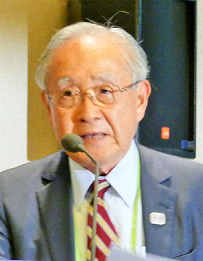
Mr. Yukitaka Ishii
Yukitaka Ishii, former president and chairman of JR Kyushu, was the only Japanese speaker at the session and spoke in fluent English as follows:
We all know that throughout history, the development of transportation has led to the development of people and the economy. This has also led to world peace. Japan's national railways have a history of 150 years, and were privatized 33 years ago.
Since 1987, I have been in charge of the privatized Kyushu Railway, serving as president for 10 years, and then as chairman. Kyushu has very close ties with China and Korea across the sea. There are various means of transportation between Fukuoka and Busan, including high-speed ferries. I would like to make two suggestions here.
The first is the idea of connecting Japan (Fukuoka) and Korea (Busan) by rail through an undersea tunnel. Currently, this is called the "Japan-Korea Undersea Tunnel" or the "Korea-Japan Undersea Tunnel." However, as a common term for both countries, I would like to call it the "Asia Straits Tunnel," following the example of the "English Channel Tunnel" across the Straits of Dover between the UK and France. What do you think? (Applause from the audience)
The Asian Straits Tunnel will not only connect Korea and Japan, but will also connect the entire Eurasian region to Europe. This will not only provide a means of transportation, but will also help solve a variety of problems, including energy and environmental issues.
My second proposal is that Asia will host the Olympic and Paralympic Games in Tokyo in 2020, and the Winter Olympics in Beijing in 2022. Taking advantage of this opportunity, I would like to strengthen connections between Tokyo, Fukuoka, Seoul, Busan, Pyongyang, Beijing, and other areas through various modes of transportation, including high-speed ferries and railways.
I also had the opportunity to visit South Korea's national railway. Of course, I'm sure there will be many difficulties in making this a reality. However, as someone involved with railways, I have no barriers of nationality, race, religion, or anything else, and I simply have a strong desire to connect the two countries on one path.
Approximately 25 speakers took to the stage at this year's International Association for Peace, Economics and Development (IAED). Several speakers used the phrase "Positive Peace," which means that economic rationality is achieved through the pursuit of peace. While each speaker's data and evidence needs to be carefully examined, these words are refreshing and promising, standing in stark contrast to the commonly held belief that "war is profitable."
(Complete)
[Akinori Kaneki]
For the full article, please see the link below:
What is the mission and responsibility of public opinion in the Internet age? (5) - Net IB News