Sekai Ilbo (Korea) December 11, 2017
There are growing calls for the construction of a Korea-Japan undersea tunnel to be actively utilized as a shortcut to peace and prosperity in Northeast Asia, taking advantage of the Northeast Asian Olympic Relay that began with the 2018 PyeongChang Winter Olympics, continued through the 2020 Tokyo Summer Olympics, and on to the 2022 Beijing Olympics.
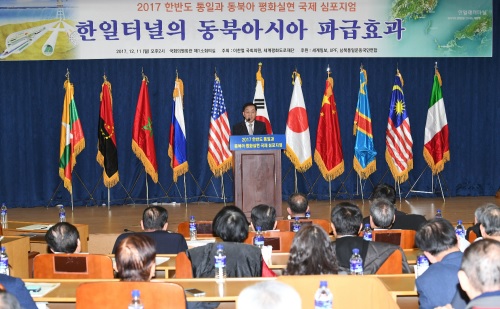
Cha Jun-young, president of the Segye Ilbo, delivers a congratulatory speech at the "2017 International Symposium for the Unification of the Korean Peninsula and the Realization of Peace in Northeast Asia - The Ripple Effects of the Korea-Japan Tunnel in Northeast Asia," held at the National Assembly Building in Yeouido, Seoul, on the afternoon of the 11th.
"If an undersea tunnel is built, it will connect to the Trans-Korean Railway (TKR), passing through China, Mongolia, and Russia, connecting the Eurasian continent by rail," said Shin Chang-cheol, a professor of Japanese language and literature at Soongsil University, at the 2017 International Symposium for Korean Peninsula Unification and Northeast Asian Peace, co-hosted by the World Peace Road Foundation (Chairman Song Gwang-seok, Korea) and the office of National Assemblyman Lee Chan-yeol at the National Assembly Building in Yeouido, Seoul, on the 11th. The theme of the tunnel was "The Ripple Effect of a Korea-Japan Tunnel on Northeast Asia." "Not only will this butterfly effect contribute to lasting peace and stability in Northeast Asia, but it will also position the Korean Peninsula at the center of Northeast Asia, making South Korea the country that benefits most," Shin said. "The Korea-Japan Tunnel could be an opportunity for the people of both countries to renew their historical understanding, resolve the territorial dispute, and serve as a shortcut to building a future-oriented Korea-Japan relationship," he emphasized.
Professor Shin analyzed the cost of building a certain Korea-Japan tunnel, stating that Japan should cover 70% of the cost and South Korea should cover around 30%, based on territory. The distance between South Korea's Geoje Island or Busan and Japan's Tsushima Island is around 50km, and based on international waters, South Korea's share of the cost would only be around 25km. He estimated the construction period to be 10 to 15 years, with total construction costs at 100 trillion won.
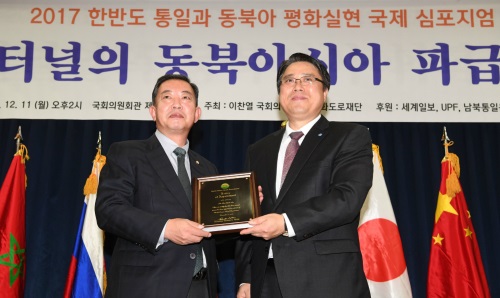
Member of the National Assembly Lee Chan-yeol receives a commission from Chairman Song Kwang-seok of Korea
Jeong Tae-ik, honorary chairman of the Korea Association for Foreign Relations, who chaired the symposium that day, said, "Next year marks the 20th anniversary of the Kim Dae-jung and Obuchi Joint Declaration on a new Korea-Japan partnership heading into the 21st century." He added, "Next year will likely be an opportunity for President Moon Jae-in and Prime Minister Shinzo Abe to make announcements regarding new Korea-Japan relations, and I believe the most important project among these will be the construction of the Korea-Japan Tunnel," drawing thunderous applause from the participants.
Nagano Shinichiro, professor emeritus at Daito Bunka University, said, "The construction of the Korea-Japan Tunnel will contribute to peace and stability in Northeast Asia, including the Korean Peninsula." He added, "With the 2018 PyeongChang Winter Olympics, the 2020 Tokyo Summer Olympics, and the 2022 Beijing Winter Olympics as golden opportunities, if we cooperate with each other, we can expedite the realization of the Korea-Japan Tunnel and peace in Northeast Asia."
In his congratulatory speech that day, Rep. Lee Chan-yeol (People's Party, Suwon City District A representative) said, "The need for a Korea-Japan undersea tunnel was first raised in political circles in 1990, and former presidents Kim Dae-jung, Roh Moo-hyun, and Lee Myung-bak have all expressed positive support for it. "A Korea-Japan undersea tunnel will not only revitalize the economy of a specific region, but will also open up a new future for the Republic of Korea and, more broadly, new horizons in Northeast Asia, and it will bring no loss to either Korea or Japan." Rep. Lim Jeong-sung (Democratic Party, Gwangju City District B representative, Gyeonggi Province) said, "Just as the Eurotunnel was built between the UK and France, who were historically enemies, and the European Community was born, I hope that connecting Korea and Japan through a tunnel will signal a new history of common prosperity and peace, after a history marked by past invasions, conflicts, and disputes."
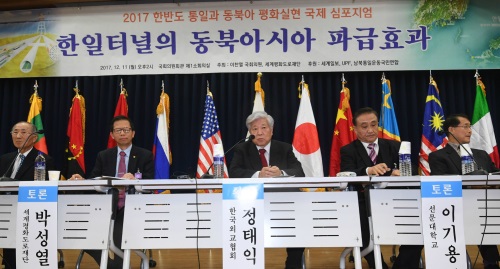
The discussion
Chairman Song Gwang-seok said, "The reason that Rev. Sun Myung Moon and Dr. Hak Ja Han Moon, who founded the World Peace Road Foundation, advocated the International Peace Expressway was to connect the world into one transportation network and realize peace in the global village." He added, "For Japan, the Korea-Japan Tunnel represents settling the bad ties of the past and moving forward to a new future, and for Korea, it represents growing into a central nation in Northeast Asia through reconciliation and forgiveness."
On the same day, the two lawmakers, Lee Chan-yeol and Lim Jeong-seon, accepted the position of advisor to the World Peace Road Foundation and received a commission certificate with the intention of actively cooperating in the Korea-Japan undersea tunnel promotion project.
Reporter Kim Min-seo
This article has been translated from Korean into Japanese.
You can download the Japanese translation PDF here.

The original PDF can be downloaded here.