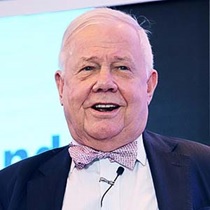
Jim Rogers
Jim Rogers, a global American investor who participated in a meeting on the situation on the Korean Peninsula and Japan-Korea relations held in Seoul, South Korea, said that if the North Korean nuclear issue is resolved and a Japan-Korea tunnel is built, the economic benefits to the region would be immeasurable, and called for the promotion of the Japan-Korea tunnel plan.
In an interview with The Washington Times, Rogers acknowledged that there are significant physical and political obstacles to building a tunnel, but pointed out that if a Japan-Korea tunnel is completed, it would open up a land transportation route from Japan to Europe. He spoke optimistically about the idea, saying, "Imagine a railway and road connecting North Korea through Russia to Paris and Rome."
During his meeting with North Korean leader Kim Jong Un, U.S. President Donald Trump stressed that North Korea has "great" economic potential if it abandons its nuclear program.
Like Trump, he pointed out that if the Korean Peninsula were denuclearized and "the issue of the 38th parallel were to disappear," the economic potential would be immeasurable. Currently, it takes about 50 days to travel from Japan to Europe by sea, but "if goods are put on trains in Japan, they can be delivered to Berlin in about three weeks," he said, arguing that this would drastically reduce transportation time.
He also pointed out that "everyone wants to get rid of the 38th parallel. China, Russia, North Korea, South Korea, everywhere," and emphasized that hopeful signs have emerged, with North and South Korea having begun removing landmines and observation posts (that have been installed in the DMZ for over 50 years) due to the reconciliation between the two Koreas since last year.
The United States is not the only country that has its eye on the economic potential of the Korean Peninsula and the effects of a Japan-Korea tunnel.
Rogers revealed that Russia is interested in the Japan-Korea tunnel, saying, "A major Russian transportation company is trying to sell the idea in Japan." He said that President Putin has been considering "rebuilding the Trans-Siberian Railway" and extending it all the way to the North Korean border in recent years.
Diplomatic sources told The Washington Times that plans are also being discussed to transport Russian natural gas to East Asia via a pipeline through North Korea.
Regarding the construction cost, estimated at $100 billion, Rogers expressed his expectations for Japan, South Korea and Russia, saying, "Russia, South Korea and Japan will all benefit. These three countries have the capital. They can raise funds for such a large-scale infrastructure project."
The Japan-Korea tunnel would also be useful in countering China's economic zone initiative, the Belt and Road Initiative. Rogers said, "Not only will it be a rival to the Belt and Road Initiative, but it will also be a competitor. By competing, it will also bring the world together."
(Special to the Washington Times)
This article is a Japanese translation of an article published in the Washington Times on May 21, 2019
.
You can download the PDF of the above article here.