Monthly Chosun December 2018 issue
by reporter Shin Seung-min
・The longest route, 231km, connects Busan/Geoje → Tsushima → Karatsu, Japan
・The Seikan Tunnel and the English Channel Tunnel have already opened in Japan... "The technical capabilities are sufficient"
・At the time of opening, the annual cargo transport volume will be 32.76 million tons, or 6.55 million containers.
・Weaknesses include construction costs of 100 trillion won, high freight rates, and a decrease in shipping volume
- Japanese promoters: "We will expedite the opening even if it means investing more manpower and money"
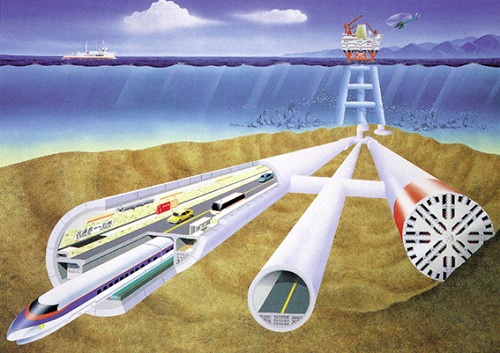
[Image of the completed Korea-Japan undersea tunnel - provided by the promotion group]
The Korea-Japan Undersea Tunnel, proposed in 1981 but stalled, is once again attracting attention. The Korea-Japan Tunnel Research Association (KJTA) held a "Korea-Japan Tunnel in the Yeongnam Region Promotion Conference" on October 31st, with 500 participants gathered on the fifth floor of the Busan Family Federation Building in Dong-gu, Busan. In his opening remarks, Lee Yong-heum, president of the KJTA, said, "Over the past 30 years, Korea and Japan have conducted extensive research on this issue. The Korea-Japan Tunnel project will bring our two countries together and essentially become key players in world peace." Park Seong-yeol, director of the KJTA, said, "A total of over 200 to 300 billion won has been invested in the Korea-Japan Tunnel project to date. It's worth it." He added, "If the KJTA's opening is delayed, Japan and Russia will connect the Hokkaido-Siberian Railway. This will block Korea's access to the Eurasian continent."
With relations between the two countries currently deteriorating due to historical issues, is a Korea-Japan tunnel politically and scientifically feasible? Are there any safety or environmental damage issues? What practical benefits would the two countries gain from it, apart from the "abstract legitimacy" of communication, restored relations, and cultural exchange? We examine the feasibility of a Korea-Japan undersea tunnel, which has been debated for decades, with progress and retreat.
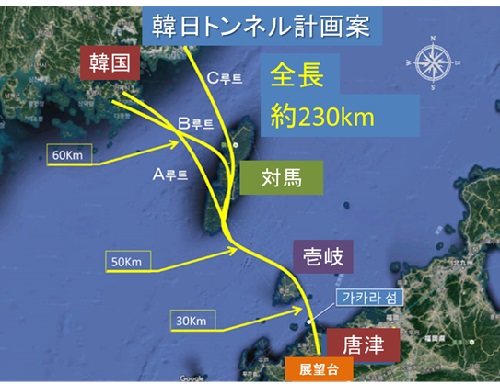
[Graphic provided by the Promotion Group]
The Korea-Japan Tunnel would connect Busan and Geoje Island in South Korea to Karatsu City in Saga Prefecture, Kyushu, Japan, via Tsushima Island. Its total length would be 209-231 km (128-145 km undersea section). Rather than a single long tunnel, it would be divided into three sections, each connecting a series of short tunnels. Proposed routes include Plan A, which would connect Geoje Island to Karatsu City via Tsushima Shimoshima and Karatsu City (total length 209 km, undersea section 145 km); Plan B, which would connect Geoje Island to Karatsu City via Tsushima Kamishima (total length 217 km, undersea section 141 km); and Plan C, which would connect Busan directly to Karatsu City (total length 231 km, undersea section 128 km).
Japan was the first to take the initiative in promoting the opening of the tunnel. After the International Highway Construction Agency was established in Japan in April 1982, the Japan-Korea Tunnel Study Group was established in May of the following year, led by Professor Emeritus Yasuo Sasa of Hokkaido University. In July of the same year, the Japanese promotion group began land and sea surveys in Karatsu City, Iki Island, and Tsushima Island in Saga Prefecture, Kyushu, Japan.
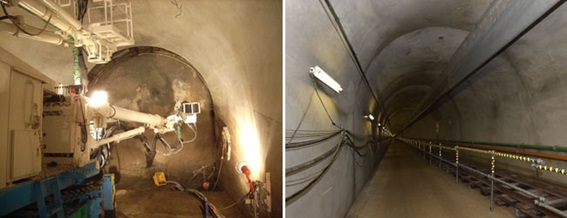
Pilot tunnel construction, or "inclined tunnel construction," began in Karatsu City in October 1986. Land, marine, and aerial topographical surveys were conducted, along with environmental dynamics surveys along the tunnel section. Phase 1 (inclined distance 10-210m) was carried out from October 1986 to September 1987, while Phase 2 (inclined distance 210-410m) was carried out from May 1988 to March 1991. Phase 3 (inclined distance 410-610m) began in October 2006 and has now been excavated to a depth of 547m. In 2014, inclined tunnel construction was completed in the Are area on Tsushima's west coast. The Japanese project team plans to resume Phase 3 construction, followed by Phases 4 (610-810m), 5 (810-1010m), and 6 (1010-1210m). Their goal is to complete all pilot and main construction works by 2030.
In South Korea, the Korea-Japan Tunnel Study Group was established in 1986 and conducted drilling surveys in five areas around Geoje Island in October 1988. In 1990, President Roh Tae-woo proposed the Korea-Japan Tunnel in a speech to the Japanese Diet, and then-Japanese Prime Minister Kaifu expressed his support. Nine years later, President Kim Dae-jung brought up the idea of a Korea-Japan Tunnel at the Korea-Japan Summit. Subsequently, President Roh Moo-hyun also mentioned the need for a Korea-Japan Tunnel in a meeting with Prime Minister Koizumi. In 2008, the Korea-Japan Tunnel Study Group and the Busan Development Institute jointly surveyed the route of a Korea-Japan Tunnel (including Iki and Tsushima in Japan). That same year, Park Sam-gu, chairman of the Kumho Asiana Group, also expressed interest in the construction of a Korea-Japan Tunnel. Recently, the Family Federation for World Peace and Unification held a commemorative event for the 30th anniversary of the start of construction at the Korea-Japan Tunnel site in Karatsu, Saga Prefecture, Japan, on November 14, 2016.

Eiji Tokuno, Chairman, International Highway Foundation
Regardless of the construction period, does Japan have the technological capabilities to dig a tunnel? Engineers from both countries, especially the Japanese, believe it's not a problem. Japan already opened the Seikan Undersea Tunnel in 1964 (a 53.9-km tunnel connecting Honshu and Hokkaido, with a 23.3-km undersea section). Japanese personnel also served as technical advisors when construction began on the Channel Tunnel in 1986 (a 49.94-km tunnel connecting Folkestone in southern England and Calais in northern France, with a 37.9-km undersea section). Engineers maintain that the water depths of the Busan Strait (western waterway of the Korea Strait), Tsushima Strait (eastern waterway of the Korea Strait), and Iki Strait, through which the Korea-Japan Tunnel would pass, are a maximum of approximately 230 meters, making construction possible using existing excavation methods.
Regarding this, Tokuno Eiji, chairman of the International Highway Foundation and head of the Japan-Korea Tunnel Promotion Group, stated in a written interview with a reporter, "It's safe to say that there is almost no risk (of the tunnel collapsing due to lack of technical ability)," and "Since the construction will avoid active faults (unstable crust that is currently active and has the potential for earthquakes) from the start, the possibility of rupture (cracks in the rock caused by man-made destruction) due to an earthquake is extremely small. It can also be said that there is almost no possibility of flooding during the construction of the main tunnel." These are his words.
"An undersea tunnel, which reduces seismic intensity to about one-tenth of that on land, is more earthquake-resistant than expected. Also, although it is a large-scale construction project, there has been almost no marine pollution or damage to the fishing industry. Because it is being dug underground, the impact on land and sea is minimal. However, the key point is how to dispose of the enormous amount of surplus soil, waste rock, and wastewater, and we are working hard to secure a location that will make this possible."
How much will both countries gain from the tunnel's opening? According to the Japanese promotion team, South Korea will see an economic ripple effect of 54 trillion won and Japan 88 trillion won. South Korea will receive 13 trillion won and Japan 18 trillion won from the construction industry alone. South Korea will gain from the development of its tourism industry, reduced logistics costs, creating political and economic conditions for unification, and securing tunnel construction technology. Japan will be able to secure its expansion into the continent and expand trade and people-to-people exchanges with North and South Korea, China, and Europe.
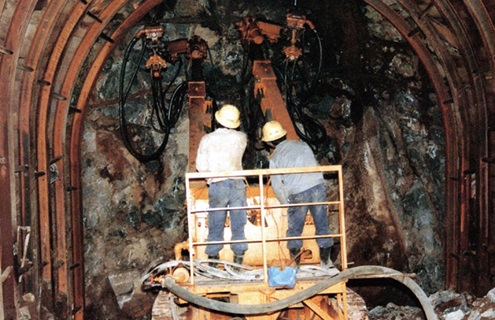
Construction site inside the inclined shaft of the Korea-Japan Undersea Tunnel in Karatsu City, Saga Prefecture, Japan.
The third phase of construction (slant distance 410-610m) has been underway since October 2006, and excavation has now been completed up to 547m.
Photo provided by the Promotion Group
According to a July 5th report in Japan's Nagasaki Shimbun, Professor Noda Junyasu of Seinan Gakuin University estimated that if the Korea-Japan Tunnel opens, annual logistics operating profits, excluding passenger demand, could reach 225.3 billion yen (approximately 2.2337 trillion won). Assuming construction begins in 2020 and it opens in 2030, the annual cargo transport volume between Japan and South Korea, China, and Russia will reach 32.76 million tons. 6.55 million containers would travel through the Korea-Japan Tunnel.
If enormous profits are generated as Professor Noda's analysis suggests, how will the two countries share them? Of the various management methods that have been proposed to date, a "public-private joint venture" structure in which both governments invest a certain amount of stock and the private sector takes the lead in exercising management rights is reportedly the most likely. Both governments would provide financial support within the scope of public interest, and the profit distribution structure in proportion to the government investment would be decided through consultations between the two countries. The private investment portion would be carried out in the form of a "consortium" (an association or union for a common purpose, a system in which large and small businesses jointly operate around a main operator) with participation from both domestic and international companies.
According to a report in the July 5th edition of the Nagasaki Shimbun newspaper, Professor Noda Junyasu of Seinan Gakuin University estimates that if the Korea-Japan Tunnel is opened, the annual cargo volume transported between Korea, China, and Russia through Japan could reach 32.76 million tons.
Photo = NEWSIS
On the other hand, some have pointed out that the economic impact of a Korea-Japan tunnel would be minimal, considering construction costs in the 100 trillion won range and the possibility of a decrease in ship traffic. In 2011, South Korea's Ministry of Land, Infrastructure, Transport and Maritime Affairs dismissed the idea of a Korea-Japan tunnel, declaring it "unreasonable" from an economic standpoint, following a feasibility study. In response, an official from Japan's International Highway Foundation said, "In the short term, there is a possibility that ship traffic volume will shrink," but added, "As the tunnel's opening improves the transportation infrastructure of both countries, the regional economies (nearby) will also develop overall. In the medium to long term, the ripple effect will dramatically increase ship traffic."
The official said, "The ideal plan (for the opening of the Korea-Japan Tunnel) would be to use the national budgets of both countries for construction and leave operation to the private sector, with revenues managed. The (initial) construction costs would be covered by the government budget, but the 'concession' method, in which the operating rights are sold to the private sector and the funds are (re)appropriated for national expenditures, has recently been used for airport construction and other projects." He added, "Just like the case of the Anglo-French Tunnel, once the (Korea-Japan Tunnel) gets on track after privatization, passenger numbers and revenues will increase."
Once the Korea-Japan Tunnel opens, how much time and how many people will travel between the two countries? A Japanese academic study published in March predicted that the number of passengers would reach approximately one million per year. Of course, this is a guess based on a lack of relevant data, so the most realistic reference is the example of the already-opened England-France Tunnel. This is because the England-France Tunnel shares many similarities with the Korea-Japan Tunnel in terms of the two countries' historical relationship, economic level, population size, existing transportation methods, and location. Since its opening in May 1994, 390 million people have used the England-France Tunnel in the roughly 10 years since its opening. In terms of freight volume, this amounted to 360 million tons, equivalent to approximately 25% of the total freight volume between the UK and continental Europe.
In terms of fares and travel time, it would be more advantageous to use air or sea transportation on the existing routes, so is there really any need to use an undersea tunnel between Korea and Japan?Furthermore, the fares of the UK-France Tunnel, which is only one-fifth the distance of the Korea-Japan Tunnel, are not cheap either, and it has been pointed out that "the fares of the Korea-Japan Tunnel could be five times higher than those of the UK-France Tunnel."
According to the Japanese promoters, the strength of the Korea-Japan Tunnel isn't its "low-cost passenger transport" but its "safety," unaffected by climate change and natural disasters. It will be "a means of transportation capable of transporting large amounts of cargo quickly and safely." An official from Japan's International Highway Foundation said, "Aircraft and ships cannot operate in all weather conditions, and there is always the risk of traffic interruptions. Aircraft, in particular, can only connect points (between specific regions), and there are limits to the number of people and cargo they can transport." "The strength of railroads and roads is their ability to operate on the ground regardless of weather conditions. The use of railroads and roads will increase the frequency of people traveling between countries, deepening friendly relations between the two countries." The proposal aims to highlight the uniqueness and high efficiency of railroads as advantages, dispelling the negative view that they are a "luxury means of transportation."
Meanwhile, some have pointed out that the undersea tunnel could contribute to Japan's expansion into the Korean Peninsula and Eurasia. South Korea has the national power to take the lead in promoting North-South unification and independently conduct northern diplomacy, so why would it cooperate with Japan? Some have pointed out that the tunnel recalls the Imjin War (1552-1559), when Toyotomi Hideyoshi, under the pretext of invading the Ming Dynasty, demanded that the Joseon court leave its floodgates and land routes open. There are also concerns that the route connecting Busan, Geoje, and Tsushima could evoke the idea of an "invasion of Korea." Some have even gone so far as to suggest a "second Japanese colonial era."
In response, Chairman Eiji Tokuno stated, "It is impossible for an industrial and tourist road to become a major military advance route," and "(In the event of war) the tunnel can be blown up and sealed off, so it cannot be used for military transport." He added, "We have no intention of pushing this forward to prioritize Japan's interests. It has great significance in realizing prosperity and peace for both countries, and ultimately the world," adding, "Japan must take the lead in opening the tunnel, even if it means providing more active support in terms of personnel and funds."
"We live in an age where it is difficult for a country to prosper without a pan-global, global perspective. Now, Japan must serve the world through its economic and technological strength. Only by doing so can it become a country worthy of the affection and respect of countries around the world. It will also be a way to apologize for the mistakes made during World War II, which caused great damage to Asian countries. If Japan naturally builds relationships with other countries through such an attitude and behavior, and if mutual trust and goodwill are cultivated, I believe that will be the country's greatest asset."
Translated the December 2018 issue of Monthly Chosun
You can download the Japanese translation PDF here.