It is hard to believe that in these times when Japan-South Korea relations are said to be at their worst in history, talk of connecting Japan and South Korea with an undersea tunnel has suddenly emerged in South Korea, and has become a point of contention between the ruling and opposition parties in the Busan mayoral election scheduled for April.
The sudden emergence of talk of a Japan-Korea undersea tunnel without any prior warning appears to have been caused by Kim Jong-in, leader of the opposition People's Power Party, visiting Busan on February 1st and pledging to build a Japan-Korea undersea tunnel connecting Gadeok Island and Kyushu, Japan, as a countermeasure to the ruling party's proposal to build a new airport in Gadeok Island as an election strategy.
Regarding this undersea tunnel controversy, which arose without Japan's knowledge, the ruling Democratic Party of Korea has criticized Kim, saying, "It is a pro-Japanese pledge that is the result of his pro-Japanese DNA." However, the People Power Party has strongly opposed this, saying, "If we label it as a pro-Japanese act that benefits the enemy, then former President Roh Moo-hyun, who assisted President Moon Jae-in as chief of staff, also advocated for an undersea tunnel, so he would also be pro-Japanese."
The idea of a Japan-Korea undersea tunnel linking Busan and Kyushu in South Korea is not a conservative idea or a "monopoly." It is a long-term vision for South Korea that has been mentioned by successive presidents, regardless of whether they are progressive or conservative.
The first person to mention the Japan-Korea undersea tunnel was President Roh Tae-woo, who mentioned it in a parliamentary speech during his visit to Japan in 1990, proposing joint construction to then Prime Minister Kaifu Toshiki. President Kim Dae-jung also said in September 1999, "If a Japan-Korea tunnel is built, it will connect Hokkaido to Europe, so it is something we should consider as a dream for the future," and proposed the idea to then Prime Minister Mori Yoshiro during his visit to Japan in September 2000.
His successor, President Roh Moo-hyun, also proposed the construction of a tunnel to then-Prime Minister Junichiro Koizumi at the Japan-South Korea summit meeting in February 2003, and his successor, President Lee Myung-bak, also announced a basic national development plan in December 2009 that included a "study on the economic and technical feasibility" of an undersea tunnel as a long-term issue for consideration.
Japan responded to this, with former Prime Minister Noboru Takeshita ordering a study. Former Prime Minister Tsutomu Hata also mentioned the idea as part of his "Japan Revitalization Program," and former Prime Minister Yoshiro Mori even proposed building a tunnel connecting Japan and South Korea and naming it the "ASEM Railway" at the ASEM meeting in October 2000. Furthermore, former Prime Minister Naoto Kan, while a member of parliament, also mentioned running a linear motor car through an undersea tunnel between Japan and South Korea.
Deputy Prime Minister Taro Aso, when he was Prime Minister, also agreed to the establishment of the "Japan-Korea New Era Joint Research Project" at a summit meeting with President Lee Myung-bak in 2009. In October 2010, the Ministry of Foreign Affairs issued a proposal for the "New Era of Japan and Korea" (Building a Complex Network for Coexistence), which included the following proposal regarding the "long-term promotion of the Japan-Korea Undersea Tunnel Project":
"The England-France undersea tunnel connecting the Straits of Dover not only expanded the flow of people and goods between the UK and France, but also played a role in connecting the island nation of the UK with the entire European continent. The construction of a Japan-Korea undersea tunnel connecting the Kitakyushu region with the Busan-Masan region will not only contribute to the expansion of the flow of people and goods between Japan and Korea, but will also be a project that connects the island nation of Japan with the entire Asian continent. The non-economic mutual exchange effects of this plan must be highly evaluated in light of the phenomenon of mass exchange between Japan and Korea and the prospects for trilateral exchange between Japan, China and Korea."
"Furthermore, the Japan-Korea undersea tunnel would not only be for Japan and South Korea. If it passes through North Korea and connects to Shenyang in northeastern China, the Northeast Asian railway network of the three countries of Japan, China and South Korea would be connected, and it would be possible to reach Europe via the Trans-Siberian Railway."
In the first place, this "Japan-Korea undersea tunnel" was a Japanese idea.
In 1935, before the war, Japan National Railways (JNR), the predecessor of JR, came up with the "Japan-Europe Railway Plan." It was a grandiose concept that would connect Kyushu, the Korean Peninsula, Mukden, Beijing, the Permir Plateau, Eastern Shanxi, and Europe, connecting with the Orient Express. Six years later, in 1941, exploration actually began on Iki and Tsushima in Nagasaki Prefecture, and drilling began in Yobuko Town in Saga Prefecture. However, the plan was thwarted by the outbreak of the Pacific War.
Given the current sharp conflict over Takeshima, no matter how much noise is made in South Korea, the idea of an undersea tunnel between Japan and South Korea is nothing more than a pipe dream that is not feasible.
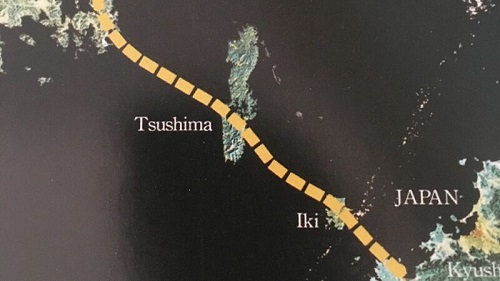
Japan-Korea Undersea Tunnel Route (from a pamphlet by the Tottori Prefectural Council for the Promotion of the Japan-Korea Tunnel)
Shinichi Hen | Journalist, Editor-in-Chief of Korea Report 2/3 (Wed) 12:17
For the full article, see the linked page