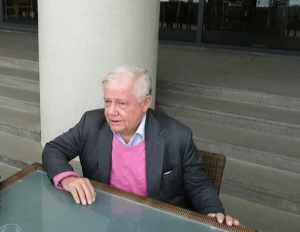
Chairman Jim Rogers gives a speech on the Korea-Japan undersea tunnel, a unified Korea, and reasons for investing in North Korea at the Ananti Cove Penthouse in Gijang County, Busan on the morning of the 21st.
Jim Rogers (77), a global investment expert and chairman of Rogers Holdings, said this in an exclusive interview with the Segye Ilbo held on the 21st at the Ananti Cove Penthouse in Gijang-gun, Busan.
The Korea-Japan Undersea Tunnel is being promoted by the Korea-Japan Tunnel Research Association (Co-chairs: Lee Young-heum and Seo Eui-taek). It will connect Busan and Geoje Island, passing through Tsushima Island and Karatsu City in Saga Prefecture, Kyushu, Japan. Its total length will be 209-231 km (128-145 km undersea). Its unique feature is that it will connect smaller tunnels at each stop, rather than a single large tunnel. This peace project began in November 1981 when Rev. Sun Myung Moon of the Family Federation for World Peace and Unification proposed the "International Highway" plan at the 10th International Conference on the Unification of Science (ICUS). Since then, Rev. Hak Ja Han of the Family Federation has continued to promote this project as part of the construction of the "Peace Road," a global highway for peace. The undersea tunnel construction is estimated to take 10-15 years and cost 62 trillion to 100 trillion won.
Chairman Rogers believes that after unification, the Korean Peninsula will play a key role as a major hub for global transportation and logistics. If the East Sea and West Sea railroads connect North and South Korea, it will connect China, Russia, and even Europe. "If an undersea tunnel between Korea and Japan is opened, it will become possible to travel overland from Tokyo to Berlin. That alone will create enormous economic value," he emphasized. "A unified Korea will not only be a welcome development for Japan. I believe it will also make it more difficult for Japan to compete with a unified Korea," he added.
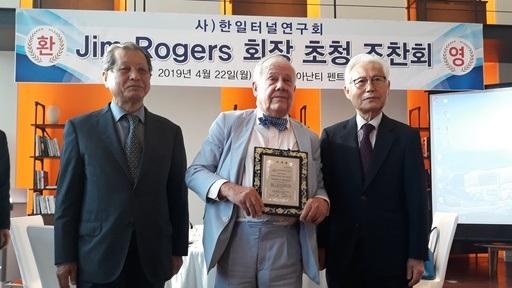
Jim Rogers was appointed advisor to the Korea-Japan Tunnel Research Association on the morning of the 22nd at the Ananti Cove Penthouse in Gijang County, Busan. From left: Lee Young-heum, co-chair of the Korea-Japan Tunnel Research Association, Jim Rogers, and Seo Eui-taek, co-chair of the Korea-Japan Tunnel Research Association. (Photo provided by the Korea-Japan Tunnel Research Association)
Chairman Rogers predicted that a unified Korea would be a major development in the tourism industry. "North Korea has not developed in terms of tourism for decades and has been closed off to the public during that time. Also, people in the United States and Europe have not considered Korea as a tourist destination," he said. "Once the two Koreas are opened up and a railway is built, many people will compete to visit both South and North Korea." He also predicted, "A unified Korea will be the most interesting country in the world."
"North Korea has an educated, cheap labor force, a rich natural environment, and underground resources, but it has not developed enough to fully utilize these. South Korea has the capital and management experience to operate production facilities," Rogers said, adding, "With significant investment on the Korean Peninsula, it will assume a geopolitically important position." He also reiterated, "This is not good news for the Korean people to hear. Over the next 10 to 20 years, the Korean Peninsula will become the most interesting and dynamic place in the world."
"I don't think the global economy will improve in one or two years, but the Korean Peninsula will not be affected much by such predictions," he said, adding, "Once inter-Korean exchanges begin, more economic benefits will emerge, leading to countless investments and prosperity. Korea will have an opportunity to 'add more good to good things.'"
Rogers, who has been expressing his intention to actively invest in North Korea for several years, said, "It is difficult to predict when South and North Korea will be unified. However, due to certain inertia, things could suddenly change like an unquenchable fire." He added, "I am confident that the era of such a 'unified Korea' will come."
On the 22nd, he was appointed honorary advisor to the Korea-Japan Tunnel Research Association. He also received an honorary doctorate from Pusan National University for his contributions to creating an atmosphere of peace on the Korean Peninsula. He received a doctorate in philosophy rather than business administration or economics, due to his deep interest and knowledge in history and philosophy. Before receiving a bachelor's degree in economics from Oxford University in 1966, Chairman Rogers received a bachelor's degree in history from Yale University in 1964. After the graduation ceremony, he gave a special lecture to students on the topic of "The Unification and Future of the Korean Peninsula," and later that afternoon, he gave a similar lecture at the Busan Bank headquarters at the invitation of BNK Busan Bank.
Jim Rogers is considered one of the world's three greatest investors, along with Warren Buffett and George Soros. A native of Alabama, he is famous for his childhood days selling peanuts and collecting empty bottles at baseball stadiums, which is how he started his business. He studied history at Yale University and philosophy, political science, and economics at Balliol College, Oxford, before working on Wall Street. He founded the hedge fund Quantum Fund with George Soros and achieved an astounding 4,200% return over 10 years, making him a global investor. After leaving Quantum Fund, he became an adventurer, successfully circumnavigating the globe three times. After selling his New York home in 2007 and relocating to Singapore, Rogers focused on the value of Asia. In 2014, he drew attention at an investment briefing in the UK, saying, "If possible, I would like to invest all my assets in North Korea."
Busan = Reporter Lee Bo-ram
This is a Japanese translation of the original Korean article from the Sekai Ilbo on April 22, 2019.
Jim Rogers, "Korea-Japan Undersea Tunnel is a Big Project for a Unified Korean Peninsula"
The original Korean PDF above can be downloaded here.