"Busan needs an undersea tunnel to become the center of the Sea of Japan Rim Economic Zone," says the city of Busan, which is launching a study this year to analyze the feasibility of building an undersea tunnel between Korea and Japan. With diplomatic relations between the two countries having deteriorated following the installation of the Peace Statue in front of the Japanese Consulate, the construction of an undersea tunnel is expected to provoke heated public debate, with both sides expressing their support for and against it.
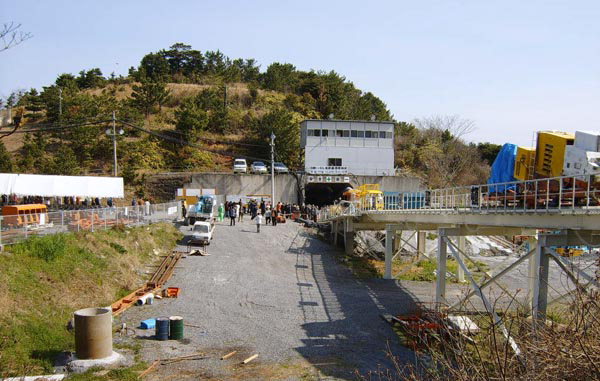
The undersea tunnel construction site in Karatsu, Saga Prefecture, Kyushu, is the starting point of the Korea-Japan undersea tunnel on the Japanese side.
At the 2017 Policy Concert held on the 10th, attended by Mayor Seo Byung-soo, Busan City announced that it would be conducting basic research for the construction of a Korea-Japan undersea tunnel, one of its strategies for the development of the western Busan region, for one year starting in March. The construction of an undersea tunnel is one of the 50 major projects in the 2030 Western Busan Global City Grand Plan announced by the city in 2015.
The undersea tunnel is necessary for Busan to become the center of the Sea of Japan economic zone connecting South and North Korea with China, Japan, and Russia, and this reflects the mayor's will. The employment cost is 100 million won.
The main research topics are: ▷Analysis of the impact of a Japan-Korea undersea tunnel on the Busan economy; ▷Public opinion survey; and ▷Feasible route. Previously, the Busan Development Institute (BDI) proposed a route from Busan's Gangseo District to Gadeok Island to Tsushima Island in Japan to Ikinoshima Island to Fukuoka (222.64km, construction cost 92 trillion won). It was found that Japan preferred a route from Karatsu in Kyushu to Ikinoshima Island to Tsushima Island to Geoje Island to Gadeok Island to Busan (288km, construction cost 100 trillion won).
The key to this is public sentiment regarding the undersea tunnel. Even among experts, there is a fierce battle between those who argue that the tunnel will not only be a symbol of economic exchange but also of joint prosperity for Japan and South Korea, and those who argue that it will serve as a passageway for Japan to advance into the continent and will have no practical benefit for Busan. The recent intensification of diplomatic tensions between South Korea and Japan over the installation of the Comfort Women Statue in Busan is also expected to have an impact on spreading negative perceptions of the tunnel.
"There are many variables in the Korea-Japan relationship, and it's true that the construction itself would be a burden. We'll first calculate the impact that the construction of an undersea tunnel would have on Busan," said Song Sam-jeong, head of the city's West Busan Development Bureau. "A Korea-Japan undersea tunnel would be impossible without national support, so we're pursuing it as a long-term project." At a discussion on a Korea-Japan undersea tunnel held by the Busan Economic Revitalization Citizens' Solidarity in November last year, Chung-Ang University professor Heo Jae-wan (specializing in urban economics) argued, "A Korea-Japan undersea tunnel would be economically viable if it were built for less than 65 trillion won."
Translated article from International Newspaper on January 10, 2017