We would like to introduce articles about the Japan-Korea Tunnel Project that have been featured in news organizations and media outlets.
The way forward for the Korean people is cooperation between North and South Korea. The Bering Strait project is a reality, not a dream.
President Lee Myung-bak's recent visit to Mongolia and Central Asia, and General Secretary Kim Jong-il's visit to Russia, have been the subject of much discussion. The coincidence that the summits of North and South Korea coincided on the issues of energy and transportation networks indicates a major survival strategy.
From August 17 to 19, an international conference entitled "Integrated Infrastructure Development in Northeastern Russia in the Sakha Republic of Russia" was held, attended by experts from various countries, including the United States, China, and Russia, including the author, who served as the South Korean representative for the Bering Strait Peace Forum, supported by the World Peace Tunnel Foundation. The main topics of the conference were (1) connecting Eurasia with North America by rail and (2) developing energy resources in the Far East.
The fact that resources and transportation networks were the topics discussed by the summits of North and South Korea and at the Sakha International Conference indicates that these are major concerns for the region. As a peninsula, we cannot help but be concerned about the future. It is also time for the leaders of North and South Korea to seek a common survival strategy for mutually beneficial relations. Seeing the in-depth discussion and promotion of the Bering Strait Project at this conference, I realized that cooperation between North and South Korea is the way to open up new avenues for the Korean people.
First, the Bering Strait Project is a business that will position the Korean Peninsula as the central region of Northeast Asia. Connecting the Korean Peninsula's railway network to the Trans-Siberian Railway will also provide momentum for the much-discussed Korea-Japan undersea tunnel project. Once the shortest land route connecting Europe and the Americas is opened, cargo from South Korea, Japan, and Southeast Asia will all be concentrated on the Korean Peninsula. The Korean Peninsula will become the Netherlands of Europe.
Second, railways and oil and gas pipelines running across the Korean Peninsula will strengthen the material foundation for co-prosperity between North and South Korea and ultimately contribute to creating an environment for unification. Korean Peninsula unification will serve as a catalyst for the formation of an East Asian community, shifting the Northeast Asian regional order from conflict to cooperation.
Third, the Korean Peninsula can become the birthplace of a new civilization, connecting the ocean and the continent. It has long been the hope of all countries involved that the United States, China, Russia, Japan, and a unified Korea will unite to create a new civilization that strives for the common prosperity and improved welfare of humanity.
The 21st century should be a century of hope, in which a new civilization is born that combines continental and maritime powers.
The Bering Strait Project, currently underway, will not only hasten the era of economic renaissance for the global village by inducing the development of Siberia and Alaska, a treasure trove of resources, but will also contribute to the creation of world peace and a welfare society for humanity. Furthermore, the Bering Strait Project is of interest to the international community in terms of the potential for resource development and the use of Arctic shipping routes. The Bering Strait Project is approaching reality rather than a dream. The era of continental and maritime integration, fulfilling the long-cherished wish of the Korean Peninsula, has begun.
- (Korea's Segye Ilbo, September 2, 2011) [Contribution] Jeong-Taeik, South Korean Ambassador to Russia
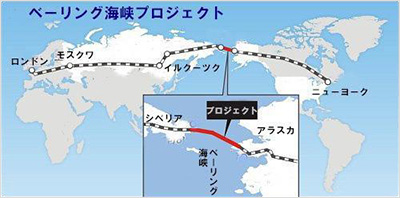 A plan to dig an undersea tunnel across the Bering Strait, which separates Eurasia and North America, and connect the two continents to railway networks has been given the green light.
According to the British daily newspaper, Daily Mail, on August 22 (local time), the Russian government has approved a plan to build an undersea tunnel across the Bering Strait by 2030.
Alexander Levintal, deputy governor of the Russian Far Eastern Federation, made the announcement at an international conference on resource development in Yakutsk, attended by experts from the US, China, and the UK.
The Bering Strait, which connects Alaska in the US and Siberia in Russia, is approximately 80 km wide, and the International Date Line runs between Big Diomedes Island (Lyongin) and Little Diomedes Island (Migkryongin) on the Russian side. As early as 21,000 years ago, some areas were above water, allowing for active human exchange between Asia and North America. The undersea tunnel to be constructed here will be approximately 105 km long, and construction costs are estimated to reach $100 billion (approximately 107.88 trillion won). For this reason, Russia has decided to first invest $1.5 billion by 2013 to extend the Trans-Siberian Railway to Yakutsk. Once the undersea tunnel is completed, it will be possible to travel by train from London, England to New York in about 15 days. Furthermore, resources that previously traveled by ship across the Pacific Ocean will be able to be transported cheaply and quickly by rail freight.
- (Korea's Segye Ilbo, August 23, 2011)