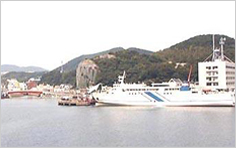
Tsushima is located 60km northwest of Iki, at the very edge of Japan, but it is also the closest to the Korean Peninsula, just 53km away, making it a remote island with an international character. The island measures 710km², making it the third largest in Japan after Sado Island and Amami Oshima. It measures just 18km east to west, but is 82km long north to south. The Japanese archipelago was once connected to the continent by land, and traces of this can be seen in the flora and fauna of Tsushima. Due to its location, it was destined to act as a bridge between the continent and Japan. As the island's record remains in the "Wei Zhi Wajin Den," it has been a point of contact with the continent since ancient times, and a key point for travel between the two.
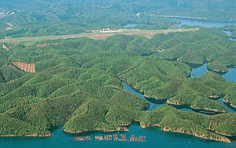
Tsushima's population of 49,000 is declining, with a noticeable outflow of young people, and the island is facing problems of depopulation and an aging population. The island is made up of six towns, with the administrative, cultural, and educational center being Izuhara Town in the south. Its population is 177,000 and its area is 177 square kilometers. To the north, it is followed by Izuhara Town, Izuhara Town, Izuhara Town, Izuhara Town, and Kamitsushima Town. Tsushima is mostly mountainous, with very little plains. Consequently, roads are scarce and winding, making transportation between towns physically difficult and hindering the island's development. National Route 382 is the only artery. The island's landscape is so beautiful that it has been designated a quasi-national park, along with Iki. The bay in the center is particularly drowned, with its complex topography creating a graceful inlet. The view from the elevated Kamimisaka slope is breathtaking.
Next, let's list the issues and problems Tsushima faces and explore how to address them.
1) Like Iki, the population has remained stable or is declining slightly, and depopulation is progressing slowly. The aging population is also progressing, just like Iki. In addition to proactively promoting local industry, encouraging young people to return to their hometowns by establishing new industries, and implementing employment measures for young people, radical "island reform" is essential.
② Tsushima is covered in 90% of its total area by mountains ranging from 200 to 600 meters high, and has little flat land. Furthermore, due to its topographical and geological conditions (mostly sedimentary rock), it is extremely difficult to carve out a city by cutting through the mountains. Therefore, in order to connect each district with a highway as a transportation trunk line, tunnels will be built through the mountains. Furthermore, this tunneling technology can be utilized to carve out mountain gaps and steep mountains to form "mountain cities." Alternatively, in areas where the mountaintops are a continuous series of hills, "hilltop towns" with great views can be formed. This will require the creation of development methods unique to Tsushima. Furthermore, the granite mined by carving out the island's interior is in extremely high demand on the mainland.
3) Tsushima is located at a distance almost equal to that of the mainland and South Korea. Currently, its proximity to South Korea is not being utilized to its full potential. It is not difficult to imagine that the opening of the Japan-Korea Tunnel will elevate Tsushima to an extremely advantageous position on the international stage. Now is the time to position it as a "super international region" and establish a "super international region" concept.
4. Like Iki, Tsushima is also revealing complexities in terms of administrative authority, economic zones, and geographical areas. If Nagasaki Prefecture continues to treat Tsushima in the same way as the Goto Islands, the question will arise as to how much Tsushima, which is at the forefront of internationalization, can withstand prefectural administration in the future. The more the Japan-Korea Tunnel becomes apparent, the more Tsushima will become an important "Dejima to the continent" for Nagasaki Prefecture. We need to consider, from both administrative and economic perspectives, how to make it easier for Tsushima to appear on the international stage.
5. Among the many beautiful zones on Tsushima, Aso Bay in the center of the island is an exceptionally spectacular sight. While taking advantage of the natural environment, we should consider developing the area around the bay and actively utilizing the scenery. Pearl farming in Aso Bay should be promoted as a local industry, and it could also be positioned as an important tourist resource if the industry is internationalized.
⑥ The development of an airport capable of taking off and landing large jet aircraft is essential for Tsushima's super-regionalization and internationalization.
Taking into account the characteristics and challenges of Tsushima mentioned above, let us consider what kind of image Tsushima should have as a "country" rather than a region when the Japan-Korea Tunnel opens.
First, let's list the image that the new TSUSHIMA should have:
① Internationality and sociability
② Cultural and academic
③ Unusual and non-Japanese (exotic)
is.
Because Tsushima's topography and geology make it nearly impossible to develop the entire area, base development should instead be carried out in selected priority areas.
Candidate sites for priority development areas include:
: 1) Izuhara/Kamimizaka area (Izuhara Town);
2) Asaji Bay outer zone (Mitsushima Town, Toyotama Town);
3) Hitakatsu area (Kamitsushima
Town); 4) Kaijin area (area surrounding Kaijin Shrine, spanning Mine Town and Kamiagata Town).
Now, let's randomly list some specific projects that should be attracted.
1. International Convention Center:
International conference hall, hotel, various sports facilities, health facilities, and shopping facilities.
2. International Medical Center
: International comprehensive adult disease medical facility. It will be a mecca for research and development of common adult intractable diseases, including cancer research in response to an aging society. It will also have a medical school, affiliated hospital, and long-term care facilities.
3. International Life Science Center:
At the intersection of natural science and social science, it will be a place where researchers from around the world can come together to conduct joint research on areas that are most closely related to human life. For example, research on interferon.
4.
Marine sports club facilities and accommodation will be established, centered around a marina, in conjunction with the functions of Marine Leisure Base 1, 2, and 3. The marina will have an ultra-luxury image, mainly for large cruisers, and will be fully equipped with facilities that will allow sailings from here to high-class marinas around the world (Greece, Spain, etc.).
Looking at the suitability of each of the facilities to be attracted to the above candidate sites, the results are roughly as follows:

Marine leisure base
in Izuhara, Kamimisaka, and Mametsu areas
② Aso Bay Outer Zone
International Convention Center
③ Hitakatsu District
International Medical Center
④ Ina-Umikami District
International Life Science Center
Of these, ③ and ④ are limited hub developments, while ① and ② will be fairly widespread regional developments. In particular, the establishment of a marina will require a fairly artificial and proactive transformation of the existing structure. Taking into consideration the redevelopment of Izuhara's central district, a group of hotels will be constructed along with the development of a waterfront with a marina. Furthermore, ②, an international convention facility to be built around Aso Bay, will be the Kyushu region's leading international attraction.
With the opening of the Japan-Korea Tunnel, Iki will continue to be part of mainland Japan as part of Kyushu, and will be positioned as a "remote" suburb of Fukuoka City and Karatsu City, becoming a "dream residential resort." On the other hand, Tsushima, due to its distance from the mainland and its topographical disadvantages, will not become a residential or mainland area, but will instead be pulled toward the continent and become "internationalized." Development based on this internationalization will be hub development rather than area-wide, and a variety of methods will be used.
In any case, both islands will be reborn as New Islands. Here, I would like to list the development requirements for creating a New Islands that will be common to both islands.
1) Building islands and towns of people and hearts. Money and things should not come first, but rather people, especially local people, must join forces, pool their wisdom, and always take the lead in development.
② Without financial support and cooperation from the national, prefectural and local governments, infrastructure development will not progress easily. In order to introduce various systems, it is necessary to thoroughly prepare advance plans.
3) Public funds will be used primarily for infrastructure development, while the islanders will have to rely on their own efforts or on the vitality of external private companies to build the structures. How to lead the "private sector" is the key to development.
4) Development through the "third sector" approach, involving cooperation between the public and private sectors, is also an effective method. In particular, for housing development in Iki, a semi-public, semi-private organization such as the Iki Resort Development Corporation would be ideal for creating an ideal town.
5) To build international facilities (especially in the case of Tsushima), it is necessary to seek funding from both national and corporate levels. Attracting foreign companies is also a possibility. Furthermore, the reduction in airfares, which is currently being reviewed, is also essential for the development of Iki and Tsushima.
6. "Development of the heart" is an urgent issue. The realization of the Japan-Korea Tunnel will inevitably call into question the dignity of the Japanese people as international citizens. "Development of the heart" and "internationalization of the heart" are necessary not only for the people of both islands but for all Japanese people. Efforts to change the Japanese character and systems, which are closed to foreigners, into ones that are more open to the outside world are essential.
 Tsushima City
The city's official website. Administrative information, statistical data, event information, and information on the Tsushima wildcat.
http://www.city.tsushima.nagasaki.jp/
Development and Outlook for the Iki and Tsushima Regions
Overview of the Japan-Korea Tunnel