The Japanese side of the Japan-Korea Tunnel will be served by an area centered around four cities: Karatsu, Taku, and Fukuoka on the Higashimatsuura Peninsula in northern Kyushu, and Tosu, which connects Fukuoka and Taku at right angles. The Japanese side of the tunnel's entrance will be supported at four points. These four city regions form an approximately rectangular shape. By examining these physical connections, we would like to provide an overview of each city's history, topography, culture, industry, and more. Of the four city regions, Fukuoka, which will not be directly affected by the tunnel and is growing as a major city, will be excluded from this analysis, remaining solely as the mother city of the other three regions.
The Karatsu-Higashimatsuura region will serve as the gateway to the Japan-Korea Tunnel. This region has long had ties with the continent and served as a point of contact with continental culture. At the same time, like Tsushima and Iki, it has faced the threat of attacks from foreign enemies, such as the Mongol invasions. It served as Toyotomi Hideyoshi's base during his Korean expeditions, and the remains of Nagoya Castle are still standing. The Matsuura clan held sway in the Middle Ages, and after the Tokugawa shogunate came into power, it entered the Meiji era as the territory of the Nabeshima domain, most of which were outside the Tokugawa shogunate. Though the Karatsu domain was small, it experienced frequent changes in feudal lords, creating a different atmosphere from the Ariake Sea region, fostering the spirit of the Karatsu people today. The coastal area is a ria coastline with frequent access points, blessed with beautiful scenery, and is included in the Genkai Quasi-National Park. The route connecting Karatsu and Fukuoka, via Saikai National Park and Unzen to Sasebo, has become an international tourist route.
The northern and western parts of the Higashimatsuura Peninsula are surrounded by a ria coastline, and the interior of the peninsula forms a wavy tabletop called a "plateau." The climate is warm, with little rainfall and few rivers. Field farming is the main industry, with a high reliance on it in Hizen, Genkai, and Chinzei. There are many small-scale farms, and land productivity is low. Industries include food manufacturing, general lumber manufacturing, and wood products. Karatsu City dominates the region. The fishing industry is most active in Yobuko Town, which has a fishing port, and is coastally dependent on methods such as purse seine, trawl net, small-scale bottom trawl, seine net, and sardine fishing. In recent years, pearl, yellowtail, sea bream, abalone, and sea urchin farming have become increasingly popular. The Higashimatsuura Peninsula has many excavated stone tools, pottery, and ancient jars, revealing traces of its ancestors dating back to the Jomon period, and many legends and romantic stories have been passed down. According to the "Wei Zhi Wajin Den," the country of "Mutsuroku" was formed in the third century. However, in modern times, due to the peninsula's characteristics as a dead end for transportation, it has been left behind in economic and social development. However, thanks to its peninsula nature, it has not been swallowed up by the wave of development, and it still has a beautiful coastline and undeveloped islands.
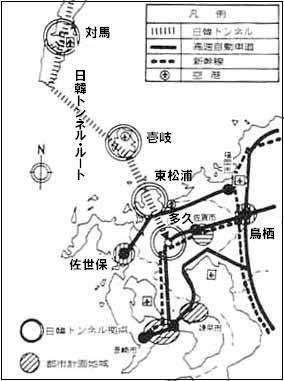
Once the Japan-Korea Tunnel opens, these constraints will be reversed. As a gateway to the continent, Karatsu City will be able to capitalize on its resort-like nature and develop it into an international recreation zone. Karatsu City is also seeking to develop as an industrial city, leveraging its long-standing tradition of Karatsu ware pottery. Pottery is being reborn as a new ceramics industry. The city is also blessed with resources as a resort tourist city. Together with the Higashimatsuura area, it could be positioned as a "Genkai Coastal Resort."
Future plans call for the Yobuko-Chinzei Zone, located directly below the entrance to the Japan-Korea Tunnel, to be developed into a world-class resort base with a super-luxury marina. A mooring port for large cruisers, yachts, and motorboats will be established. Furthermore, a villa area with chalk-white buildings reminiscent of those found on the Mediterranean and Aegean coasts and islands in Europe will be developed on Kabe Island. These luxury villa areas will be designed to accommodate not only Japanese visitors, but also East Asian and Western visitors. Three- to four-story condominiums will be built around the marina, creating a marine shopping zone.
Additionally, detached villa areas will be built across the scenic coastal and inland areas. The gently undulating terrain of the Higashimatsuura Peninsula makes it ideal for golf courses. Forests and some farmland will be converted to build golf courses in several locations. Tennis courts, swimming pools, aerobics centers, and other facilities will also be built adjacent to the courses.
Taku City, located in the center of Saga Prefecture, is a basin surrounded by the Chikushi Mountains, with elevations ranging from 300 to 1,000 meters. Rivers originating from the surrounding mountains flow into the Taku River, which flows through the city's center. Mandarin orange cultivation is thriving at the foot of the mountains. Taku's history dates back to before the Meiji Restoration, when it prospered through coal mining. The Karatsu Line opened early, resulting in rapid growth during the Meiji, Taisho, and Showa periods. However, after the mines closed, the population plummeted, and the city began transforming into a rural industrial city, focusing on mountainside agriculture and utilizing former coal mine sites. With the completion of the Kyushu Transverse Expressway and the establishment of an interchange on the outskirts of Taku City, the city became a gateway to the center of the prefecture. This development holds the key to the city's development into the 21st century. The Confucius Temple, the oldest surviving Confucius temple in the world, is designated a National Important Cultural Property. Taku has long been a center of culture and education, and has the potential to develop into a "research and education city" in the future.
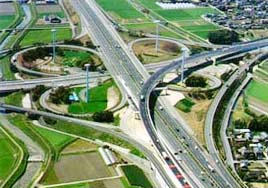
*Tosu Interchange (IC), a strategic point in Kyushu
Tosu City is the eastern gateway to Saga Prefecture. Bordering Fukuoka Prefecture, it is the junction of JR Kyushu's Nagasaki Main Line and Kagoshima Main Line, and has been a key transportation hub since the days of the Ritsuryo system. In recent years, it has become the most important land transportation hub in Kyushu, with one of Japan's largest interchanges on the Kyushu Expressway. In addition to its convenient transportation location, Tosu City has a thriving industry, and boasts the highest industrial shipment value in the prefecture, surpassing Saga City. Together with the neighboring city of Kurume, it has been designated the "Kurume-Tosu Technopolis," and is aiming to develop into one of Kyushu's leading new industrial regions.
East Asia is also a Confucian cultural sphere, so why not establish an "International Confucian University" or "Confucius University" in Taku and make it an international mecca for Confucianism? The faculties would include a Faculty of Business Administration, a Faculty of Politics, a Faculty of Human Studies, and a Faculty of Production Science, and create a town through industry-academia collaboration. Students would of course be recruited from all over East Asia.
Once the Japan-Korea Tunnel opens, Taku City will become a hub for the Kyushu Trans-Kyushu Expressway. The region enjoys a temperate climate, shielded by mountain ranges from the cold winds of the Sea of Japan. The area connecting Taku and Tosu will attract cutting-edge industrial factories and research institutes, creating a Taku-Tosu Silicon Valley comparable to California's Silicon Valley. The surrounding area will also feature industrial housing, sports facilities, and resort-style housing in a work-life zone. The Yoshinogari ruins, believed to be the ancient capital of Yamataikoku, are important for tracing the roots of Japanese culture. A Yamataikoku History Museum, showcasing Japan's ancient culture, will be built here. The
impact and benefits of the Japan-Korea Tunnel connecting Tsushima, Iki, and northern Kyushu will be immeasurable. This region needs to be developed as a base square for East Asia (a reception base for a quadrilateral structure). A master plan, equivalent to the national land plan for the entire Kyushu region, will be necessary. Just as Kitakyushu was in ancient times, the completion of the Japan-Korea Tunnel will make this region a major hub for international exchange linking Japan and Asia. In particular, East Asia is the most dynamic region in the 21st century, and the key to its economic growth is economic and technological exchange with Japan, so the importance of this international exchange hub open to East Asia cannot be overemphasized. Since the Meiji Restoration, Japan has long pursued a policy of "leaving Asia and joining Europe," but it is now on the verge of entering a new era of "leaving Europe and joining Asia."
Development and Outlook for the Northern Kyushu Region
Overview of the Japan-Korea Tunnel